
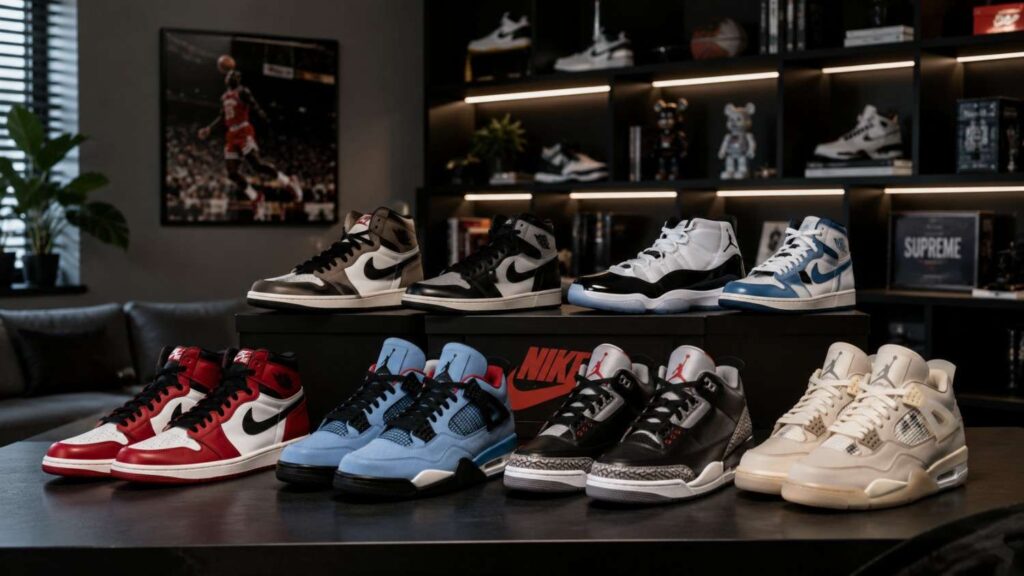
Top 10 Sneakers Every Collector Should Own
The top 10 sneakers every collector should own are not necessarily the ten shoes with the highest resale values or the smallest production numbers. Prices change quickly, collaborations can become overexposed, and limited releases sometimes lose attention once the next launch arrives. A foundational collection should instead represent the designs, technologies, sporting movements, and cultural communities that helped shape modern footwear.
This list includes basketball shoes that became streetwear standards, running models that turned performance technology into visible design, football footwear adopted by fashion audiences, and skate shoes that moved from local scenes into global culture. Each silhouette also offers several sensible entry points. A collector may choose an original colourway, a faithful retro, an influential collaboration, or a general release that reflects personal taste.
In my experience, the strongest collections tell an understandable story. They may show how leather basketball shoes replaced earlier canvas designs, how visible cushioning changed product marketing, or how musicians and skaters gave new meaning to footwear originally created for sport. The collection becomes more valuable intellectually when the owner understands why each model matters.
The overview below provides a practical starting point:
| Sneaker | Original category | Core collector value |
|---|---|---|
| Air Jordan 1 | Basketball | Athlete branding and Jordan history |
| Nike Air Force 1 | Basketball | Streetwear and regional culture |
| Nike Dunk Low | Basketball and skateboarding | Colourways and collaborations |
| Nike Air Max 1 | Running | Visible cushioning and design innovation |
| New Balance 990 | Running | Premium performance and understated style |
| ASICS GEL-LYTE III | Running | Technical design and collaboration history |
| adidas Superstar | Basketball | Hip-hop and shell-toe heritage |
| adidas Samba | Football | Terrace, indoor, and fashion culture |
| Converse Chuck Taylor | Basketball | Early sports and youth-culture history |
| Vans Old Skool | Skateboarding | Sidestripe identity and skate heritage |
The following sections explain how to select the right version of each silhouette and why these models remain essential across different types of sneaker collections.
How to Choose the Right Version for Your Collection
Choosing the right version of an iconic sneaker requires more thought than selecting the rarest listing or the colourway with the highest asking price. Collectors should consider historical relevance, visual identity, condition, authenticity, production age, wearability, and personal meaning. A pair should add a clear chapter to the collection rather than functioning as an isolated purchase driven by temporary attention.
Begin by deciding what type of collector you want to be. Some people focus on original colourways, while others specialise in collaborations, a single designer, a sports era, or one particular model. Wearable collectors may prefer recent retros with modern materials and dependable construction. Archival collectors may accept greater fragility in exchange for original packaging, production details, or historical importance.
Budget also affects the correct choice. A recognisable general release may explain a silhouette more effectively than an obscure limited edition that costs several times as much. The most useful question is not, “Which pair is worth the most?” It is, “What does this pair contribute to the collection?”
Condition must be evaluated in relation to age. Unworn sneakers are not automatically safe to wear, particularly when foam, glue, air units, or synthetic materials have deteriorated. A lightly worn recent pair may be more practical than an older deadstock shoe.
The two principles below provide a disciplined selection framework. First, understand the model through a historically recognisable colourway. Second, verify authenticity, condition, and completeness before paying a collector-level price. These steps create a stronger foundation for later collaborations and specialised releases.
Collectors who are still building their rotation may also find this guide to sneaker collection essentials useful for understanding how foundational silhouettes fit into a well-balanced collection.
Start With an Original or Recognisable Colourway
Original colourways provide immediate historical context because they show how the sneaker was presented during its earliest or most influential period. The black-and-red Air Jordan 1, white-on-white Air Force 1, red-and-white Air Max 1, grey New Balance 990, and black-and-white Vans Old Skool communicate the identities of their silhouettes without requiring additional explanation.
An original colourway does not have to be an original production pair. Early sneakers may suffer from deteriorating adhesives, hardened rubber, damaged foam, cracked synthetic materials, or weakened air units. A carefully produced retro can preserve the visual story while offering better wearability and easier replacement.
Collectors should also distinguish between historically original colours and later colourways that became culturally important. Some collaborations, regional editions, and music-related releases developed their own significance even though they were not part of the initial launch.
I recommend establishing the model’s basic visual language before moving into experimental versions. Once the collector understands the core shape, materials, and colour blocking, unusual collaborations become easier to evaluate. This approach also prevents a collection from becoming dominated by hype releases that share little visual or historical connection.
A recognisable colourway should still reflect personal taste. If a classic version would remain unworn because it does not suit the collector’s style, a later but meaningful release may be the better long-term choice.
Verify Authenticity, Condition, and Completeness
Resale purchasing requires a systematic review of both the sneaker and the seller. Compare the listing with official product images and reliable references. Request clear photographs of size labels, stitching, logos, heel construction, midsoles, outsoles, insoles, boxes, lace bags, spare laces, accessories, and any collaboration-specific packaging.
Condition descriptions should be read carefully. Terms such as “deadstock,” “new without box,” “worn once,” or “vintage condition” may be interpreted differently by individual sellers. Ask about sole separation, cracking, heel drag, yellowing, odour, missing insoles, damaged air units, hardened foam, and previous repairs.
Authentication programmes can reduce risk, but they should not replace buyer attention. eBay states that eligible sneakers carrying its Authenticity Guarantee badge undergo a multi-point inspection to assess authenticity and whether the item matches the listing. Eligibility and availability depend on location, category, model, price, and programme terms. (ebay.com)
Completeness matters differently to different collectors. An on-foot wearer may care mainly about shoe condition and authenticity. An archival collector may place greater value on original boxes, tissue paper, receipts, hangtags, extra laces, special inserts, and collaboration accessories.
Document significant purchases by saving receipts, listing screenshots, authentication records, and photographs. Good documentation supports future research, insurance, resale, and collection management while creating a reliable history for each pair.
| Sneaker Category | Key Models | Original Purpose | Why Collectors Value Them | Best Starting Choice |
|---|---|---|---|---|
| Basketball | Air Jordan 1, Air Force 1, Nike Dunk Low | Professional basketball | Rich history, iconic colorways, strong cultural influence | Air Jordan 1 or Air Force 1 |
| Running | Air Max 1, New Balance 990, ASICS GEL-LYTE III | Performance running | Innovative cushioning, premium materials, timeless design | Air Max 1 |
| Court & Football | adidas Superstar, adidas Samba | Basketball and indoor football | Global streetwear impact and classic styling | adidas Samba |
| Canvas & Skate | Converse Chuck Taylor, Vans Old Skool | Basketball and skateboarding | Everyday versatility with decades of cultural relevance | Vans Old Skool |
Basketball Icons Every Sneaker Collector Should Know
Basketball has supplied many of the most influential sneaker silhouettes ever created. Performance shoes designed for professional and collegiate athletes gradually moved into everyday wardrobes, music scenes, skate communities, fashion collections, and resale markets. Their transition demonstrates how sporting equipment can become a cultural object with meanings far beyond its original function.
The three basketball models in this section represent different collector narratives. The Air Jordan 1 established a powerful connection between an individual athlete and a signature product line. The Air Force 1 developed from an on-court shoe into a regional streetwear standard with unusually broad appeal. The Nike Dunk began as a college basketball design before skateboarders and collaborators transformed it into one of the most flexible canvases in sneaker culture.
Each silhouette also supports several types of collecting. A historically focused collector may prioritise original team colours, early retros, or releases associated with a particular athlete. A design-focused collector may study changes in materials, shape, branding, and construction across production periods. A collaboration specialist may build around artists, skate shops, fashion labels, musicians, or regional projects.
These models remain accessible in some versions while becoming extremely scarce in others. That range allows beginners and advanced collectors to participate without following the same strategy. A new collector can begin with a widely available colourway and still own a culturally meaningful design.
Together, the Air Jordan 1, Air Force 1, and Dunk Low explain how basketball footwear became one of the foundations of modern sneaker collecting.
| Buying Factor | Why It Matters | Collector Tip |
|---|---|---|
| Authenticity | Prevents purchasing counterfeit sneakers | Buy from trusted retailers or authenticated resale platforms |
| Original Colourway | Represents the model’s historical identity | Start with classic releases before collaborations |
| Condition | Affects long-term value and wearability | Inspect materials, stitching, soles, and packaging |
| Comfort & Fit | Encourages regular wear instead of storage only | Choose the correct size for your intended use |
| Cultural Significance | Adds historical importance to a collection | Prioritize sneakers with lasting influence over short-term trends |
| Personal Preference | Creates a meaningful collection | Collect models that match your style and interests |
1. Air Jordan 1
Released in 1985 and designed by Peter Moore, the Air Jordan 1 established the visual language of Michael Jordan’s signature footwear line. Its high-top structure, Wings logo, Swoosh placement, contrasting panels, and connection to Jordan’s early professional career made it one of the most recognisable sneakers in the world. Nike’s historical material identifies 1985 as the original release year and Moore as the designer. (nike.com)
The model is essential because it links performance basketball, athlete marketing, fashion, collecting, and resale culture. Original-style colourways such as Chicago, Black/Red, Royal, and Shadow provide strong historical entry points, although availability and price vary considerably.
Collectors should pay attention to cut, shape, leather texture, colour accuracy, branding, and production-year differences. High, Mid, and Low versions serve different markets and should not be treated as identical simply because they share the Jordan 1 name.
For a first pair, a well-executed high-top release in a recognisable colour scheme offers the clearest historical connection. However, a restrained general release that suits the owner’s wardrobe may provide more practical value than an expensive pair kept permanently in storage.
The Air Jordan 1 belongs in an essential collection because it represents the moment when a basketball shoe became a long-term cultural platform rather than a product tied only to one sporting season.
2. Nike Air Force 1
Bruce Kilgore designed the Air Force 1, and Nike introduced the model in 1982 as a performance basketball shoe. The sneaker later moved into everyday streetwear and became strongly associated with city style, music, regional releases, customised pairs, and collector collaborations. Nike’s archive describes its early history and the transition from court use into broader cultural adoption. (nike.com)
The white-on-white low-top remains the clearest starting point because it allows the shoe’s sculpted cupsole, perforated toe box, layered panels, and substantial proportions to remain visible without distraction. The all-white version also demonstrates how condition and maintenance can affect a sneaker’s appearance.
Collectors interested in deeper history can explore high-top releases, regional colourways, premium leathers, anniversary projects, artist collaborations, and versions associated with particular cities or music communities. Shape and material quality may vary between production periods, so comparison is valuable.
The Air Force 1 is unusual because it remains widely available while also supporting highly specialised collecting. A general-release pair can be culturally authentic rather than merely an entry-level substitute.
Its collector importance comes from longevity, recognisability, and adaptability. Few models have moved so effectively between performance history, everyday uniform, artistic canvas, and luxury reinterpretation while maintaining a consistent core identity.
3. Nike Dunk Low
Nike created the Dunk for the 1985–86 college basketball season through its College Colors Program. The design used bold team-inspired colour blocking and drew from existing Nike basketball language. During the 1990s, skateboarders adopted discounted pairs because the shoes offered a low profile, durable construction, and accessible pricing. Nike later developed the Dunk Low Pro SB with skate-specific changes, including additional padding. (nike.com)
The Dunk is important because it shows how a community can redefine a product. What began as a college basketball shoe became a central platform for skate shops, artists, fashion labels, musicians, food-inspired concepts, and regional storytelling.
Collectors can choose among standard Nike Dunks, Nike SB releases, collegiate colourways, premium materials, and major collaborations. Because the market contains many versions, selective buying is essential. Not every limited release carries lasting design or cultural value.
A two-tone collegiate-style pair provides a clear foundation, while a meaningful SB or collaboration can add a more specialised chapter. Examine tongue construction, padding, materials, box era, accessories, and collaboration details when researching older pairs.
The Dunk Low belongs in a collector’s rotation because it connects basketball, skateboarding, streetwear, collaboration culture, and the modern release system. It rewards both broad historical collecting and highly focused specialization.
Related Articles
Running Icons That Changed Sneaker Design
Running footwear introduced many of the technologies, materials, and visual structures that later became central to lifestyle sneakers. Cushioning systems, breathable mesh, stabilising overlays, layered midsoles, and technical construction gradually moved from performance equipment into everyday fashion. Collectors who focus only on basketball miss a major part of sneaker design history.
The three running models in this section represent different approaches to performance and cultural adoption. The Nike Air Max 1 turned cushioning into a visible design feature, making technology part of the shoe’s visual identity. The New Balance 990 demonstrated that understated colours, premium construction, and technical performance could support long-term lifestyle appeal. The ASICS GEL-LYTE III brought distinctive engineering and layered 1990s styling into collaboration-driven collecting.
Running shoes also introduced a different collector language. Rather than focusing mainly on athletes and team colours, enthusiasts may study cushioning generations, mesh-and-suede combinations, manufacturing locations, technical updates, regional collaborations, and design changes across versions.
Wearability is another reason these models remain important. Many running-derived silhouettes can function comfortably within daily rotations, allowing collectors to experience the designs rather than preserve them only for display.
However, older performance shoes may contain foam and cushioning components that deteriorate. Collectors should assess production age before wearing vintage pairs and should not assume that a deadstock shoe remains structurally sound.
Together, the Air Max 1, New Balance 990, and GEL-LYTE III demonstrate how technical running design became one of the strongest influences on modern sneaker culture.
4. Nike Air Max 1
Tinker Hatfield designed the Air Max 1 after taking inspiration from Paris’s Centre Pompidou and its exposed structural elements. Released in 1987, the shoe made Nike Air cushioning visible through a window in the midsole. This transformed an internal performance technology into a central design feature and created a visual language that influenced later Air Max models. (nike.com)
The original white, grey, and red colourway offers the clearest collector entry point because it highlights the visible Air unit and layered upper. The white, grey, and blue version provides an equally recognisable alternative. Anniversary retros and carefully shaped reissues may appeal to collectors who value proportions close to earlier releases.
More advanced collecting can include atmos collaborations, regional projects, premium materials, concept-driven colourways, and releases connected to Air Max Day. Shape, mudguard height, materials, and colour accuracy may differ between production periods, making comparison important.
The Air Max 1 belongs in an essential sneaker collection because it changed how performance technology was presented. The visible window was not simply a mechanical feature; it became a storytelling device that allowed consumers to see the cushioning they were being asked to value.
Its influence extends beyond Nike. The model helped establish technical visibility as a major part of sneaker design, advertising, and collector interest.
5. New Balance 990
The original New Balance 990 arrived in 1982 after the company set out to develop an advanced running shoe without allowing a conventional price target to limit the design. New Balance notes that the original appeared in an understated grey colourway and carried an unusual three-figure price at launch, positioning it as a premium technical product. (newbalance.com)
The 990 became important because it combined performance engineering with restrained visual design. Rather than relying on bright colour blocking, the model used grey suede, mesh, reflective details, and careful proportions to communicate seriousness and quality.
Collectors can explore several generations, including the original-inspired versions and later 990v2, v3, v4, v5, and v6 developments. Each version changes cushioning, panel structure, shape, and overall character while maintaining the family identity.
A classic grey Made in USA pair offers the clearest entry point. It represents the model’s connection to American manufacturing, technical running, understated fashion, and the modern preference for comfortable lifestyle sneakers.
The 990 deserves a place in a balanced collection because it expands the definition of sneaker importance. Its influence comes not from a single athlete or controversial release but from consistency, comfort, material quality, and decades of quiet cultural adoption.
6. ASICS GEL-LYTE III
Designed by Shigeyuki Mitsui and introduced in 1990, the ASICS GEL-LYTE III is recognised for its split-tongue construction, layered upper, and GEL cushioning. ASICS continues to describe current OG releases as maintaining the model’s early-1990s shape, tooling, and signature tongue design. (asics.com)
The split tongue gives the shoe a visual and functional identity that separates it from conventional running models. Its suede, mesh, and synthetic panel combinations also make it well suited to colour-driven collaborations and material experimentation.
The GEL-LYTE III became particularly important within boutique and collaboration culture. Retailers, designers, artists, and regional partners used the model to create detailed concepts that appealed to collectors seeking alternatives to dominant basketball silhouettes.
A balanced suede-and-mesh colourway provides a strong starting point because it reveals the panel structure and original technical character. More advanced collectors may explore celebrated collaborations, anniversary releases, Japanese editions, or pairs connected to specific retail partners.
The model broadens an essential collection by representing 1990s technical running from a major Japanese brand. It also demonstrates that collector significance can develop gradually through design distinction, community support, and thoughtful collaborations rather than a single mass-market cultural moment.
Court and Football Classics With Global Influence
Not every influential sneaker emerged from American basketball or performance running. Court and football footwear created slimmer, lower-profile designs that later moved into music, terrace culture, fashion, and everyday streetwear. Their appeal often comes from simplicity, recognisable construction, and the ability to work across different styles and generations.
The adidas Superstar and adidas Samba represent two distinct sporting origins. The Superstar began as a leather basketball shoe and later became deeply connected to hip-hop, particularly through Run-DMC. The Samba developed from football-focused footwear and gradually moved through indoor sport, terrace style, youth culture, and fashion.
These models are important for collectors because they show how cultural adoption can become more influential than the original performance purpose. A sneaker may begin with technical goals, but musicians, supporters, stylists, and local communities can redefine what the shoe represents.
Both silhouettes also provide accessible starting points. Classic black-and-white or white-and-black versions remain widely recognisable, while premium materials, collaborations, regional editions, and historical reproductions provide more advanced collecting paths.
Collectors should pay attention to shape, tongue design, sole construction, materials, branding, and production variations. Similar-looking adidas models may belong to different historical families, so research is useful before purchasing.
Together, the Superstar and Samba demonstrate the international reach of adidas and the importance of European sporting design within global sneaker culture. They also add visual contrast to a collection dominated by bulkier basketball and technical-running silhouettes.
7. adidas Superstar
The adidas Superstar was developed at the end of the 1960s and publicly debuted around 1970 as a leather low-top basketball shoe with a distinctive rubber shell toe. The leather construction offered a different approach from many earlier canvas basketball shoes, while the shell toe provided a recognisable visual and protective element. (adidas.com)
The Superstar later became strongly associated with hip-hop culture, particularly through Run-DMC. That relationship helped establish the sneaker as more than a former performance model. It became a symbol of music, street identity, and the growing connection between artists and footwear brands.
A white leather pair with black 3-Stripes is the clearest collector choice because it highlights the shell toe, cupsole, and branding. Black-based versions and vintage-style releases provide alternative historical references.
Collectors can also explore music collaborations, anniversary editions, premium leather versions, artist projects, and regional releases. Differences in shell shape, leather quality, tongue construction, and overall proportions may affect the character of each edition.
The Superstar belongs on this list because it records the movement of sneakers from professional sport into music-led street style. It remains accessible enough for new collectors while offering sufficient history and variation for advanced enthusiasts.
Its importance does not depend on scarcity. The model proves that cultural endurance can be more meaningful than limited production.
8. adidas Samba
The Samba traces its origin to 1950, when adidas developed footwear intended to provide traction for football training in difficult winter conditions. The company states that a version recognisable as the modern Samba appeared in 1972 with redesigned construction and a football-focused outsole. (news.adidas.com)
The model’s low profile, gum sole, leather upper, suede toe reinforcement, and T-toe structure gave it a practical identity that later moved beyond sport. It became associated with indoor football, terraces, European street style, music communities, and eventually global fashion.
A classic black or white leather Samba with a gum sole provides the strongest foundation pair. It communicates the silhouette clearly and works naturally within everyday rotations.
Collectors can later explore long-tongue versions, premium leather editions, collaborations, regional releases, and related terrace models. Care is needed because the popularity of the Samba has produced many similarly styled shoes that may have different histories and construction.
The Samba belongs in a serious collection because it demonstrates how functional football footwear can remain relevant across decades. Its influence is based on continuity rather than dramatic technology.
The model also offers an important lesson for collectors: a simple, durable design can become culturally powerful when different communities repeatedly adopt it for their own purposes.
Canvas and Skate Icons With Lasting Cultural Value
Canvas and vulcanised sneakers demonstrate that collector importance does not require complex cushioning, premium leather, or limited-edition technology. Some of the most influential shoes in history rely on straightforward materials, flexible rubber soles, recognisable branding, and designs that communities can easily personalise.
The Converse Chuck Taylor All Star and Vans Old Skool represent different stages in this story. The Chuck Taylor connects modern collecting to the early history of basketball footwear and later became associated with musicians, artists, students, subcultures, and everyday wear. The Old Skool emerged from skateboarding and helped establish the Vans Sidestripe as one of the most recognisable marks in youth footwear.
These models often remain affordable compared with limited basketball collaborations, making them valuable entry points for new collectors. Their availability does not reduce their importance. In fact, widespread use is part of their cultural history.
Collectors can focus on original-style colourways, vintage production details, premium reinterpretations, special materials, music collaborations, or releases connected to particular scenes. Wear patterns may also be interpreted differently. Some collectors value pristine canvas, while others believe these shoes gain character through regular use.
Both models provide strong contrast within a collection. Their slim profiles, vulcanised soles, and relatively simple uppers balance bulkier running and basketball designs.
The Chuck Taylor and Old Skool complete the list because they represent community-driven cultural value. Their importance comes from decades of adoption, personalisation, and repeated reinvention rather than technical complexity or resale exclusivity.
9. Converse Chuck Taylor All Star
The All Star lineage began in 1917 with Converse’s Non-Skid, one of the company’s early basketball-specific shoes. Converse renamed the model the All Star in 1919, employed basketball player and salesman Chuck Taylor in 1922, and added his signature to the ankle patch in 1934. (converse.com)
The shoe’s canvas upper, rubber toe cap, ankle patch, and vulcanised sole created a simple structure that could be produced, worn, and personalised widely. Although its performance role diminished as basketball footwear evolved, the design remained culturally active.
Musicians, artists, students, skaters, and youth movements repeatedly adopted the Chuck Taylor. Its blank canvas encouraged drawing, distressing, customisation, and individual expression, helping the shoe move beyond a single sport or generation.
A black or optical-white high-top is the most recognisable collector choice. The Chuck 70 offers a more substantial interpretation with vintage-inspired details and may appeal to collectors seeking a different material feel.
Vintage pairs, made-in-USA examples, music collaborations, patterned editions, and limited projects can provide specialised collecting paths. However, a standard pair still carries genuine historical importance.
The Chuck Taylor belongs in any discussion of iconic sneakers because it connects current collecting to the earliest decades of athletic footwear while remaining wearable and relevant today.
10. Vans Old Skool
Vans introduced the Old Skool in 1977 as Style 36. It was the first Vans shoe to feature the Sidestripe and one of the brand’s early designs to combine durable suede panels with canvas. The stripe began as a doodle by co-founder Paul Van Doren and became the company’s defining visual symbol. (vans.com)
The Old Skool was created within a Southern California skate environment, but its influence expanded through BMX, punk, hardcore, hip-hop, art, fashion, and global youth culture. The shoe’s padded collar, low profile, vulcanised sole, and reinforced panels made it practical while preserving a distinctive appearance.
The black suede-and-canvas version with a white Sidestripe is the essential starting point. It shows the design clearly and remains easy to integrate into a wearable rotation.
Collectors can explore premium Skate versions, Vault-era releases, artist collaborations, band projects, luxury reinterpretations, and regionally significant colourways. Differences in sole construction, padding, materials, and shape may influence both wear and collector interest.
The Old Skool completes the list because it represents skateboarding’s lasting impact on global style. It also shows how a functional youth-culture shoe can become a worldwide classic without abandoning its original visual identity.
Its collector value comes from authenticity, continuity, and the enormous range of communities that have made the design their own.
Quick Answer About the Top 10 Sneakers Every Collector Should Own
The top 10 sneakers every collector should own are the Air Jordan 1, Nike Air Force 1, Nike Dunk Low, Nike Air Max 1, New Balance 990, ASICS GEL-LYTE III, adidas Superstar, adidas Samba, Converse Chuck Taylor All Star, and Vans Old Skool. Together, these models represent major developments in basketball, running, football, skateboarding, music, fashion, and youth culture.
A new collector does not need the rarest collaboration or oldest production pair of every silhouette. A historically recognisable retro, well-chosen general release, or personally meaningful colourway can provide a stronger foundation than an expensive shoe purchased only because of its resale value. Original colour schemes are useful because they explain the visual identity of a model, but later collaborations and regional releases may be equally important within a specialised collection.
Collectors should consider authenticity, condition, size, wearability, production age, packaging, and personal relevance before purchasing. Older shoes can deteriorate even when they appear unworn, while newer retros may offer a more practical way to experience the design. It is also important to decide whether the collection is intended primarily for display, regular wear, historical study, resale, or a combination of those goals.
The best sneaker collection is not simply the most expensive one. It is a collection with a clear point of view, reliable documentation, and meaningful connections between models, sports, designers, communities, and cultural moments.
Frequently Asked Questions About the Top 10 Sneakers Every Collector Should Own
Questions about the top 10 sneakers every collector should own often focus on rarity, original colourways, resale value, storage, and whether important pairs should ever be worn. These questions do not have one universal answer because sneaker collecting includes several different approaches.
Some collectors build wearable rotations and judge a purchase by comfort, styling versatility, and cultural meaning. Others preserve deadstock examples, document packaging, and study production changes across different years. Specialist collectors may focus on one athlete, designer, brand, sport, collaboration partner, or silhouette.
The best strategy begins with a clear purpose. Decide whether the collection is intended for regular wear, historical study, display, resale, or a combination of these goals. That decision affects which condition is acceptable, whether packaging matters, and how much age-related risk you can tolerate.
New collectors should avoid assuming that rarity automatically creates quality or importance. A widely available original-style model may provide more historical value than a limited release with a weak story. General releases can also serve as dependable wearers while scarce pairs remain protected.
Advanced collectors may place greater emphasis on production codes, box eras, sample status, manufacturing differences, accessories, receipts, and provenance. However, the same core principles remain useful: research the model, verify authenticity, assess condition, and understand why the pair deserves space.
The following answers address common People Also Ask-style questions while keeping the advice practical for different budgets and collecting styles.
What shoes should every sneakerhead own?
A balanced collection should include at least one historically important basketball shoe, one running icon, one skate model, and one simple court or canvas sneaker. The Air Jordan 1, Nike Air Max 1, adidas Superstar, Converse Chuck Taylor, and Vans Old Skool provide a strong cross-category foundation.
However, no collector needs to follow an identical checklist. Someone interested in running technology may prioritise the New Balance 990 and ASICS GEL-LYTE III, while a basketball-focused collector may build more deeply around Jordan, Air Force 1, and Dunk releases.
The goal is to represent important design and cultural movements rather than accumulate ten unrelated expensive shoes. Original-style colourways can help explain each model clearly, but personally meaningful collaborations may also belong in the collection.
Begin with authentic pairs you can afford comfortably. Research their histories, wear them if appropriate, and allow your interests to become more specific over time. The strongest collections usually develop through curiosity rather than pressure to complete a predetermined list immediately.
What is the best first sneaker for a collection?
The best first sneaker is an authentic pair that you genuinely want to own, can afford without financial strain, and can use according to your collecting goals. A classic Air Force 1, Samba, Superstar, Chuck Taylor, Old Skool, Air Max 1, or accessible Air Jordan 1 can provide meaningful history without requiring a rare resale purchase.
Choose a recognisable colourway so the model’s design remains easy to understand. Review sizing carefully, particularly when buying older releases or switching between brands.
A wearable pair may be better for a beginner than a fragile vintage shoe. Wearing the sneaker helps you understand its materials, proportions, comfort, and styling potential.
Avoid beginning with an expensive collaboration you have not researched fully. High prices can create unnecessary pressure and may distract from learning the fundamentals of condition, authenticity, and model history.
A strong first pair should create curiosity about the next one. It should help you identify whether you are most interested in sport, technology, fashion, music, collaborations, or a particular brand.
Does a sneaker collection need rare shoes?
No. A collection does not need rare shoes to be historically meaningful, visually coherent, or personally valuable. General releases, original colourways, and regularly available classics can provide a stronger foundation than unrelated limited editions purchased only because of scarcity.
Rarity can add interest when it is connected to an important story, collaboration, material innovation, regional release, or cultural moment. However, limited production alone does not guarantee good design or long-term significance.
Widely available sneakers often have enormous cultural value because millions of people wore them. The white Air Force 1, black Chuck Taylor, and black-and-white Old Skool are important partly because of their broad adoption.
Collectors should ask what each pair contributes. Does it represent a designer, technology, community, sport, or period that matters to the collection? If the answer is clear, the shoe can be valuable without being rare.
A collection built around thoughtful selection will usually age better than one organised only around release difficulty or resale prices.
Should collectors wear their sneakers?
Collectors can wear their sneakers, preserve them, or use a mixed approach. The correct choice depends on the purpose of the collection and the condition of each pair. Wearing shoes may reduce resale value, but it also allows the owner to experience the design as intended.
Many collectors keep one pair for display and another for regular wear when a model is especially important. Others rotate all their shoes carefully and accept natural signs of use.
Older sneakers require caution. Foam may crumble, glue can separate, rubber can harden, and air units may fail even when the shoes have never been worn. Deadstock condition does not guarantee structural safety.
Before wearing a vintage pair, inspect the midsole, outsole, glue lines, cushioning, and upper. Flex the shoe gently and avoid using a fragile pair for long or demanding activity.
There is no moral requirement to keep shoes unworn. Collecting can be archival or experiential. The important point is to make the decision knowingly and understand the consequences for condition, longevity, and value.
Are original colourways better for collecting?
Original colourways often provide the clearest historical connection because they show how a sneaker was introduced or first became culturally important. They are particularly useful for collectors building a foundational history of a model.
However, original colours are not automatically superior to every later release. A collaboration, regional edition, athlete-exclusive design, or culturally important retro may have greater relevance within a specialised collection.
Personal meaning should also be considered. A colourway connected to the collector’s first pair, favourite musician, local shop, team, or important life event may deserve priority over a historically original scheme.
Condition, production quality, shape, and wearability can differ between retros. A newer original-style release may be more practical than an older pair with ageing materials.
I recommend understanding the original visual identity first, then expanding according to personal interests. This creates a collection with both historical structure and individuality.
The best colourway is the one whose design, story, condition, and relevance justify its place beyond temporary market attention.
How can I avoid buying fake collectible sneakers?
Begin with authorised retailers, official brand channels, or established resale services that offer clear buyer protections. When using an independent seller, review feedback, account history, return terms, payment methods, and the quality of the listing.
Compare the pair with official product photographs and reliable references. Inspect size labels, stitching, panel shapes, logos, insoles, heel construction, midsoles, outsoles, boxes, paper, accessories, and production codes. Counterfeit quality varies, so one detail should not be used as the only test.
Request current photographs rather than relying entirely on stock images. Ask the seller to include a handwritten date or specific angle when necessary.
Authentication programmes can reduce risk, but buyers should understand programme eligibility and dispute procedures. Keep receipts, screenshots, messages, and authentication records.
Be cautious when the price is significantly lower than the wider market without a clear explanation. Urgency, pressure, and refusal to provide details are warning signs.
When uncertainty remains, walking away is usually less costly than trying to recover money from a fraudulent transaction.
Conclusion
The top 10 sneakers every collector should own provide a practical history of modern sneaker culture. The Air Jordan 1, Air Force 1, and Dunk demonstrate how basketball footwear influenced athlete branding, street style, skateboarding, collaboration culture, and resale. The Air Max 1, New Balance 990, and ASICS GEL-LYTE III represent different approaches to performance running, cushioning, technical design, and lifestyle adoption.
The adidas Superstar and Samba show how European sporting footwear moved into music, terrace culture, fashion, and everyday streetwear. The Converse Chuck Taylor All Star connects contemporary collecting to the early history of basketball shoes, while the Vans Old Skool represents skateboarding’s long-term influence on global youth style.
Collectors do not need to purchase every silhouette immediately or chase the most expensive release. Begin with the models that connect most strongly to your own interests. Choose authentic pairs, research their histories, and decide whether each shoe is intended for wear, display, resale, study, or a combination of those purposes.
Original colourways provide a useful foundation, but later collaborations and personal stories can make a collection distinctive. Condition, documentation, sizing, and material age should receive as much attention as market value.
A meaningful sneaker collection develops gradually. Its strongest pairs are not simply those that other people recognise. They are the sneakers that help the owner understand design, sport, music, community, and personal taste more clearly.
Many long-standing style editors also highlight these essential sneaker models as timeless additions to a collection because of their lasting influence on fashion and footwear culture.