
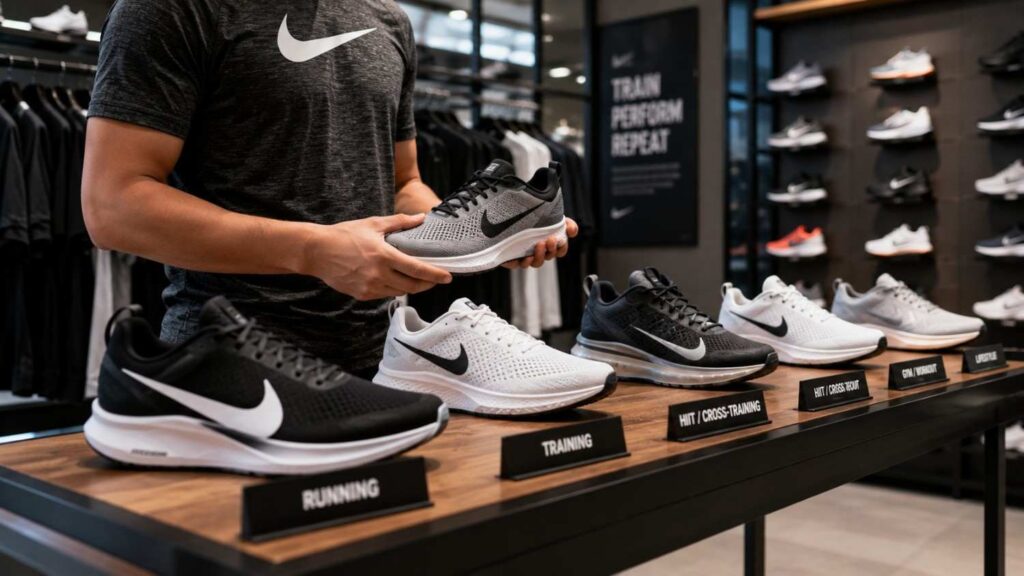
How to Choose the Right Nike Sneakers for Your Workout
Learning how to choose the right Nike sneakers for your workout becomes much easier once you stop searching for a single shoe that supposedly performs every type of exercise equally well. Running, strength training, HIIT, weightlifting and trail workouts place different demands on the body. The shoe that feels excellent during a five-kilometre run may not provide the stable platform you want during a heavy squat session.
Nike develops different footwear categories for this reason. Running shoes generally focus on repeated forward movement, cushioning and smooth transitions. Training footwear must often handle more varied movement patterns, including jumping, lunging, changing direction and lifting weights. Specialist weightlifting footwear goes further by prioritising a stable base and controlled foot position instead of the softer ride commonly associated with running shoes.
A useful buying process therefore starts with your most frequent workout. Consider what percentage of your training involves running, strength work, cardio intervals or multidirectional movement. You can then compare cushioning, stability, outsole traction, flexibility and fit within the correct Nike footwear category.
This approach also prevents you from choosing shoes based only on appearance or popularity. The best Nike sneakers for workouts are not necessarily the newest or most visually striking pair. They are the shoes that match your training demands, fit your feet comfortably and support the movements you perform most often.
Start by Matching Your Nike Shoes to Your Workout
The first step in choosing Nike workout shoes is identifying what your training actually involves. Many shoppers begin with colour, design or a familiar product name, but athletic footwear should be selected around movement. A road runner repeatedly moves forward through thousands of steps, while a gym athlete may squat, jump, lunge, push a sled and change direction within the same session.
Nike’s training shoe guidance also emphasises matching footwear features such as stability, flexibility and traction to the type of workout.
Running footwear is therefore built around different priorities from gym-focused training shoes. Nike’s own guidance distinguishes running shoes from training shoes because running is primarily linear, while strength training and functional workouts often require stability in several directions. This difference affects the midsole, heel structure, flexibility and outsole design. Understanding it can immediately eliminate models that do not suit your main activity.
You should also consider how specialised your routine has become. Someone who exercises three times a week using moderate weights and short cardio intervals may value versatility. A regular distance runner will normally benefit more from dedicated running footwear, while an athlete focused on heavy barbell lifts may want a firmer platform. Instead of asking which Nike shoe is “best,” ask which shoe is best for the exact movements you perform most frequently.
Running Needs Different Support From Gym Training
Running generally involves repeated forward motion, so Nike sneakers for running are designed around cushioning, transitions and comfort over repeated steps. Your foot lands, absorbs impact, moves through the stride and pushes forward again. For someone covering regular treadmill or road mileage, a shoe that makes this cycle feel comfortable and consistent will usually be more useful than one built primarily for lateral gym movement.
Gym workouts can be much less predictable. A single session might include squats, walking lunges, box jumps, kettlebell swings and side-to-side agility work. These exercises can place greater emphasis on lateral support, ground feel and stability. That is why Nike training shoes often use a different balance of cushioning and structure from dedicated running footwear.
The practical takeaway is simple. If most of your workout consists of running, start within Nike’s running range. If your sessions mainly involve strength training, HIIT or multidirectional exercises, begin with training models instead. Choosing the correct category first saves time and reduces the chance of buying a shoe that feels comfortable but performs poorly for your primary activity.
Mixed Workouts Need More Versatility
Many people do not train like pure runners or dedicated lifters. A typical gym session may start with five or ten minutes of cardio, move into dumbbell or barbell exercises, include kettlebell circuits and finish with short bursts of higher-intensity conditioning. These workouts require footwear that can transition between several movement patterns without feeling excessively soft or overly rigid.
The Nike Free Metcon 7 is designed around this type of mixed training. Nike combines a flexible forefoot with a more stable heel so the shoe can support dynamic movement while still providing a useful base during strength exercises. That balance makes it relevant for people whose training contains both cardio and lifting rather than being dominated by one activity.
Versatility always involves compromise, however. A mixed-training shoe will not necessarily feel as cushioned as a dedicated distance-running model or as rigid as a specialist weightlifting shoe. The benefit is convenience. If your workouts regularly combine moderate strength work, bodyweight movements, machines and short cardio intervals, a versatile Nike cross-training shoe can reduce the need to change footwear during the session.
Which Nike Sneakers Are Best for Different Workouts?
There is no single Nike sneaker that should automatically be recommended for every workout. The better approach is to match specific footwear families to specific training goals. Nike’s range includes shoes designed for road running, mixed gym work, strength-heavy cross-training and dedicated weightlifting, so each category should be judged according to the movements it was built to support.
For most shoppers, three questions narrow the choice quickly. First, how much running do you perform? Second, how heavy and technically demanding is your strength work? Third, does your workout involve frequent changes between lifting, jumping and cardio? Your answers can point you toward Pegasus, Metcon, Free Metcon or Romaleos without requiring you to compare every available Nike shoe.
The table later in this guide offers a quick comparison, but understanding the purpose behind each model is more useful than memorising product names. Pegasus prioritises everyday running. Metcon places greater emphasis on stability and functional gym training. Free Metcon offers a more flexible compromise for mixed sessions. Romaleos moves into specialised weightlifting territory. Once these roles are clear, the right choice becomes far less confusing.
| Workout Type | Primary Footwear Priority | Key Shoe Characteristics | Nike Category to Consider | Important Selection Factor |
|---|---|---|---|---|
| Road Running | Smooth forward movement | Responsive cushioning, comfortable transition, road-focused outsole | Pegasus | Running frequency and mileage |
| Strength Training | Stability and power transfer | Stable heel, supportive platform, firm base | Metcon | Lifting intensity and exercise type |
| HIIT | Stability with movement flexibility | Lateral support, traction, flexible forefoot | Metcon / Free Metcon | Balance of jumps, cardio and strength |
| Mixed Gym Training | Versatility | Flexible forefoot, stable heel, adaptable cushioning | Free Metcon | Amount of cardio versus lifting |
| Heavy Weightlifting | Maximum stability | Rigid midsole, raised heel, wide heel platform | Romaleos | Squat and Olympic lifting demands |
| Trail Running | Grip and terrain control | Trail traction, durable outsole, responsive cushioning | ACG Pegasus Trail | Surface and terrain difficulty |
| Support-Focused Running | Stability during running | Supportive cushioning, secure midfoot feel | Structure | Individual support preference |
| Maximum-Cushion Running | Underfoot comfort | High cushioning, soft and protective ride | Vomero | Distance and comfort preference |
Nike Pegasus 42 for Everyday Running
For regular road running, the Nike Pegasus 42 is a logical place to begin. Nike positions Pegasus as an everyday running family, which means it is designed for runners who want a versatile option for routine mileage rather than an extremely specialised racing or gym shoe. The model focuses on responsive cushioning and a ride suitable for common daily running sessions.
The Pegasus 42 uses Nike cushioning and a full-length Air Zoom unit intended to support comfortable transitions across different running paces. That makes the shoe relevant for treadmill sessions, outdoor road runs, easy mileage and general fitness running. Someone building a regular running habit will normally benefit more from these priorities than from the firmer, flatter feeling of a strength-focused training shoe.
It is important to recognise what Pegasus is not designed to do. I would not choose it as my first option for repeated heavy squats, deadlifts or Olympic lifting. The cushioning that helps make running comfortable is not the same feature lifters usually prioritise when they want maximum stability under load. For runners, however, Pegasus remains a practical everyday starting point.
Nike Metcon 10 for Strength and Cross Training
The Nike Metcon 10 is designed for people whose workouts contain substantial strength training along with functional or high-intensity movements. Compared with a road-running shoe, the Metcon places much more emphasis on providing a secure base. This matters when you are squatting, deadlifting, performing cleans or moving through exercises where excessive softness under the foot can feel unstable.
Nike equips the Metcon 10 with a Hyperlift plate under the heel, while ReactX foam and flex features help prevent the shoe from becoming useful only for static lifting. This balance allows the model to handle exercises such as box jumps, kettlebell work and short sprints in addition to barbell movements. That is why it fits the cross-training category better than a specialist lifting shoe.
Choose the Metcon 10 when strength work is a major part of your routine but you still need some movement versatility. It is particularly relevant for functional fitness, circuit training and gym sessions built around compound exercises. If most of your exercise is distance running, however, a dedicated running model remains the more appropriate choice.
Nike Romaleos 4 for Dedicated Weightlifting
The Nike Romaleos 4 belongs in a different category from general gym sneakers. It is designed specifically for weightlifting, where stability, foot security and efficient force transfer matter more than soft cushioning or running comfort. Athletes performing Olympic lifts, deep squats or other strength movements may prefer this more specialised structure over a versatile training shoe.
Nike uses a rigid midsole, raised heel, wide heel base and adjustable straps in the Romaleos 4. These features help create a secure platform when the athlete is lifting significant weight. The raised heel can also change ankle and squat mechanics compared with flatter training shoes, which is one reason dedicated lifters often use specialist footwear.
The trade-off is versatility. Romaleos 4 would not be my recommendation for treadmill running, longer cardio sessions or workouts dominated by jumping and multidirectional movement. It is best treated as a purpose-built tool. If weightlifting is only a small part of your routine, Metcon may offer a more practical compromise. If serious lifting is your priority, Romaleos deserves consideration.
Related Articles
How Nike Metcon, Free Metcon and Running Shoes Compare
Comparing Nike footwear becomes easier when you focus on the main job each shoe is expected to perform. A common mistake is comparing features without considering context. More cushioning is useful in some workouts but unnecessary in others. A firmer heel can feel excellent under a loaded squat yet less comfortable during longer running sessions. Features only make sense when connected to a training goal.
Nike’s current range can broadly be separated into running, mixed training, strength-focused training and specialist lifting categories. Pegasus represents everyday responsive running. Structure adds a support-focused option for runners, while Vomero sits within the maximum-cushioning category. Metcon and Free Metcon address gym training from different angles, and Romaleos is designed for dedicated weightlifting.
The best comparison therefore looks at movement, stability, cushioning and surface together. Runners should ask how the shoe handles repeated mileage. Lifters should consider the stability of the platform. Mixed-training athletes need enough flexibility to move dynamically without feeling unstable during resistance work. The following comparison gives a practical starting point before you evaluate personal fit.
Workout Shoe Comparison Table
| Workout | Recommended Nike Option | Main Benefit | Best For |
|---|---|---|---|
| Road running | Pegasus 42 | Responsive cushioning | Treadmill and road mileage |
| Strength-focused cross-training | Metcon 10 | Stability plus mobility | Lifting, functional fitness, HIIT |
| Mixed gym workouts | Free Metcon 7 | Flexible forefoot and stable heel | Cardio plus weights |
| Dedicated weightlifting | Romaleos 4 | Rigid and stable lifting platform | Squats and Olympic lifting |
| Support-focused running | Structure | Supportive cushioning | Runners wanting additional stability |
| Maximum-cushioned running | Vomero | Maximum cushioning category | Comfortable daily mileage |
| Trail running | ACG Pegasus Trail | Trail traction and responsive cushioning | Mixed terrain and trails |
This table should be used as a shortlist rather than a final buying decision. Two people can perform similar workouts yet prefer different levels of cushioning, width or flexibility. The purpose of the comparison is to identify the Nike category most closely aligned with your main exercise.
Nike currently organises its major road-running families around distinct cushioning experiences. Pegasus focuses on responsive cushioning, Structure emphasises supportive cushioning, and Vomero represents the maximum-cushioning category. Those differences are useful because they allow runners to refine their choice after deciding that a running shoe is appropriate.
For gym training, the distinction is based more heavily on stability and movement. Metcon suits strength-focused cross-training, Free Metcon provides a more flexible mixed-workout experience, and Romaleos targets dedicated lifting. This structure makes it easier to avoid comparing products that were created for completely different purposes.
When the Free Metcon 7 Makes More Sense Than Metcon 10
The Free Metcon 7 makes the most sense when your workout contains meaningful amounts of both strength work and dynamic movement. Someone who performs dumbbell exercises, bodyweight circuits, rowing, short cardio bursts and mobility-based movements may find a highly rigid shoe restrictive. Free Metcon is designed to offer more flexibility while maintaining enough stability for general strength training.
Nike positions the model with a flexible forefoot and a more secure heel, creating a balance between movement freedom and gym support. This design can be valuable during lunges, burpees, short conditioning intervals and exercises that require the foot to flex naturally. It is therefore one of the more versatile Nike training shoes for mixed workouts.
The Metcon 10 becomes the stronger choice when heavy strength work takes priority. Its stability-focused design better suits athletes who regularly perform heavier squats, deadlifts and functional strength sessions. Put simply, choose Free Metcon when movement variety matters most and Metcon when stability under load matters more. Neither option is universally better; the correct choice depends on how your training is structured.
Choose Cushioning and Support Based on How You Run
Once you know that running is your primary activity, the next decision involves the type of ride you prefer. Not every runner wants the same amount of softness, responsiveness or support. Nike separates its main road-running footwear into different families so runners can choose according to comfort preference and the type of experience they want underfoot.
The important point is that “more cushioning” does not automatically mean “better.” A runner who likes a responsive, balanced feel may prefer Pegasus. Someone looking for a more supportive experience may consider Structure, while another runner may prefer the softer, more cushioned approach associated with Vomero. Your running distance, pace and personal comfort all influence which option feels most natural.
Nike’s running shoe guidance provides additional context for comparing cushioning, support and fit when choosing footwear for regular running.
Surface should also be considered at the same stage. Road shoes are developed around relatively predictable pavement or treadmill conditions. Trail running introduces loose dirt, gravel, rocks, wet sections and uneven surfaces, making outsole traction and stability more important. Matching both cushioning preference and training surface gives you a much more accurate way to select Nike sneakers for running.
Responsive, Supportive or Maximum Cushioning
Nike’s road-running lineup can be understood through three broad cushioning experiences. Pegasus is positioned around responsive cushioning, giving runners an everyday option that can work across a range of common training paces. This makes it suitable for runners who want one dependable shoe for regular mileage without moving into a highly specialised category.
Structure focuses on supportive cushioning. Nike designs the line for runners who want additional stability and a more guided feeling through the stride. Support should still feel comfortable rather than intrusive, so the best way to determine whether Structure is right for you is to compare it directly with a more neutral everyday running option.
Vomero represents Nike’s maximum-cushioning family. It is aimed at runners who value a softer, more cushioned experience for daily mileage. None of these categories is automatically superior. The correct choice depends on what feels natural to your foot, how much cushioning you enjoy and the distances you normally run. Comfort over repeated mileage should be more important than simply selecting the shoe with the most foam.
Road and Trail Running Require Different Outsoles
Road and trail running place very different demands on the outsole. Roads, pavements and treadmills provide relatively consistent surfaces, so road-running shoes can focus heavily on smooth transitions, weight and cushioning. Trail surfaces are less predictable and may include gravel, soil, rocks, roots, slopes and wet sections that require stronger traction.
The Nike ACG Pegasus Trail is developed for mixed terrain and road-to-trail use. Compared with a standard road-running model, trail footwear generally uses outsole patterns designed to improve grip when the ground becomes loose or uneven. This helps runners feel more secure when moving away from smooth pavement.
You do not need a trail shoe simply because you occasionally run through a park. If most of your mileage happens on roads or treadmills, a road model such as Pegasus will usually be more practical. Choose trail-specific footwear when off-road surfaces are a regular and meaningful part of your training. Matching the outsole to the surface can improve confidence and prevent you from relying on a road shoe where additional grip would be more useful.
| Shoe Feature | What It Supports | Most Relevant Workouts | Why It Matters |
|---|---|---|---|
| Responsive Cushioning | Repeated forward movement | Road running, treadmill running | Helps create a smooth and energetic running feel |
| Stable Heel | Weight-bearing movements | Strength training, cross training, HIIT | Provides a more secure base during lifts and dynamic exercises |
| Flexible Forefoot | Natural movement and transitions | HIIT, mixed workouts, cardio circuits | Makes switching between exercises easier |
| Rigid Midsole | Power transfer and stability | Heavy weightlifting, Olympic lifting | Reduces unwanted movement during strength-focused exercises |
| Raised Heel | Lifting position and stability | Squats, Olympic lifting | Supports a more specialised lifting setup |
| Wide Heel Platform | Stable lifting base | Heavy strength training | Helps provide a secure foundation under load |
| Outsole Traction | Grip and surface control | Trail running, HIIT, gym training | Helps maintain contact with different training surfaces |
| Midfoot Support | Stable running transition | Support-focused road running | Provides additional structure for runners who prefer a supportive feel |
| Toe Room | Natural toe movement | Running, gym training, mixed workouts | Helps improve overall fit and reduces restrictive pressure |
| Secure Heel Lockdown | Foot stability inside the shoe | Running, jumping, lateral training | Reduces unwanted heel movement during activity |
How Should Nike Workout Shoes Fit?
Choosing the correct Nike model is only half of the process. A shoe that matches your workout category can still be a poor choice if it does not fit your foot properly. Width, toe space, heel security and overall comfort should therefore be evaluated before you decide that a shoe is right for long-term training.
The American Academy of Orthopaedic Surgeons advises choosing footwear that fits both the shape of your foot and the activity you perform. This is important because size numbers alone do not guarantee a good fit. Different models can feel different even when the printed size is identical, and people with wider feet should not automatically solve the problem by purchasing an unnecessarily longer shoe.
Fit should also be evaluated under realistic conditions. Your feet can feel different depending on socks, activity and time spent standing or moving. Whenever possible, try workout shoes with the type of socks you normally wear and pay attention to how the heel, forefoot and toe box feel during movement. Immediate comfort is a much better sign than hoping an uncomfortable shoe will somehow become perfect later.
Check the Toe Box and Heel
A good workout shoe should provide enough room for your toes without allowing your foot to slide around inside the shoe. Nike’s running fit guidance suggests leaving roughly a thumb’s width between the end of the longest toe and the front of a running shoe. This space can help prevent the toes from repeatedly pressing against the upper during running.
Heel fit is equally important. Your heel should feel secure when you walk, run or perform training movements. Excessive slipping can make the shoe feel unstable and may cause friction. At the same time, the heel area should not feel painfully tight or create obvious pressure that becomes uncomfortable within minutes.
The midfoot should feel held rather than compressed. If the upper stretches excessively or the sides of your feet feel squeezed, you may need a different width or model rather than simply a longer size. Always judge the entire fit rather than focusing on one measurement. Comfortable toe space, stable heel lockdown and appropriate width should work together as one system.
Test Shoes in Conditions Similar to Your Workout
You will get a more accurate idea of fit when you test shoes under conditions that resemble your real training environment. Start by wearing the same type and thickness of socks you normally use during workouts. A thick training sock can change how a shoe feels compared with a thin casual sock, particularly around the heel and toe box.
Move in ways that reflect your activity. Runners can walk briskly or jog briefly when store conditions allow. Gym users can perform a bodyweight squat, controlled lunge or small lateral movement to check whether the heel stays secure and the forefoot feels comfortable. These simple movements often reveal issues that are difficult to notice while standing still.
One thing I always recommend is paying attention to immediate discomfort. Athletic shoes should not require a painful break-in period before becoming usable. Slight material adaptation is normal, but obvious pressure, numbness, pinching or heel movement should not be ignored. A shoe that feels wrong during a short fitting session is unlikely to become a reliable training partner later.
A Step by Step Way to Choose Nike Workout Shoes
You do not need to study every sneaker in Nike’s catalogue before making a sensible choice. A structured elimination process is much more efficient. By moving from workout type to movement pattern, then to surface, fit and comfort, you can reduce dozens of possible shoes to a much smaller group that genuinely suits your needs.
The process begins with the activity you perform most often. This matters because an occasional warm-up jog should not outweigh forty minutes of strength training when you are choosing footwear. Likewise, someone who runs five days a week should not select a gym-focused shoe simply because they perform a short resistance session after one of those runs.
After identifying your dominant activity, think about how specialised your training has become. Beginners and general fitness users often benefit from versatile footwear. Advanced runners, competitive lifters and people training for specific events may gain more from specialised shoes. The six-step process below works for both groups because it starts broad and becomes more specific only when necessary.
Steps 1 to 3: Identify Your Training Needs
Step 1 is to choose your main activity. Decide whether most of your weekly training consists of road running, treadmill sessions, strength training, HIIT, mixed gym workouts, weightlifting or trail running. Do not base the decision on what you occasionally do. Use the activity that accounts for the largest and most important part of your programme.
Step 2 is to identify your primary movement pattern. Repeated forward movement usually points toward running footwear. Squats, lunges, jumps and side-to-side movements place greater emphasis on training-shoe stability. Heavy Olympic lifting creates even more specific requirements, which is where dedicated shoes such as Romaleos can become relevant.
Step 3 is to decide how much specialisation you need. Free Metcon 7 may suit mixed training, while Metcon 10 better fits strength-heavy cross-training. Pegasus 42 serves everyday road running, and Romaleos 4 is intended for dedicated lifting. Choosing the category at this stage prevents you from becoming distracted by shoes that were never designed for your main goal.
Steps 4 to 6: Check Fit, Surface and Comfort
Step 4 is to match the outsole to your training surface. Indoor gym floors, treadmills, roads and trails create different demands. A road-running outsole does not need the same aggressive grip as trail footwear, while gym shoes need traction that works during strength and multidirectional movements on indoor surfaces.
Step 5 is to evaluate fit carefully. Check toe room, width, heel lockdown and midfoot comfort. Wear the socks you normally use and perform a few movements that resemble your workout. The shoe should feel secure without painful squeezing, excessive slipping or obvious pressure points.
Step 6 is to let comfort decide between suitable options. Once two shoes both match your activity and fit requirements, personal preference becomes important. One may feel slightly firmer, softer or more flexible. Choose the pair that feels best for your body rather than the pair receiving the most attention online. Following these steps is a reliable way to understand how to choose the right Nike sneakers for your workout without overcomplicating the decision.
Common Mistakes When Buying Nike Workout Shoes
Many disappointing footwear purchases are caused by choosing the right brand but the wrong type of shoe. Nike offers many performance models, yet each one is built around different priorities. A shoe can be high quality and still be unsuitable for your workout. Understanding the most common mistakes can therefore save money and improve your training experience.
The first mistake is assuming all athletic shoes are interchangeable. Running shoes, cross-training shoes and weightlifting shoes may look similar from a distance, but their midsoles, heel structures and outsole designs can serve very different purposes. Using one category for an activity it was not designed around may create unnecessary compromises in comfort or stability.
The second mistake is expecting one shoe to perform every task equally well. Versatile Nike training shoes can cover a wide range of general fitness activities, but serious distance running and heavy lifting sit at opposite ends of the footwear spectrum. Once your training becomes more specialised, owning separate shoes may make more sense than forcing one pair to handle completely different demands.
Using Running Shoes for Every Gym Exercise
Running shoes can feel extremely comfortable because cushioning is one of their major design priorities. That comfort sometimes leads people to use them for every gym activity, including heavy squats and other movements where a more stable platform may be preferable. Softness underfoot is useful during repeated running steps, but it is not automatically the best characteristic under a heavy load.
Nike distinguishes running footwear from training footwear because gym training often involves multidirectional movement. Training shoes must support exercises such as lunges, jumps, strength work and agility drills rather than only repeated forward motion. Their design can therefore provide a different balance of stability, flexibility and ground feel.
This does not mean you must change shoes for every light exercise. Casual machine work or moderate gym activity can be performed in many comfortable athletic shoes. The issue becomes more important as lifting intensity, lateral movement or training volume increases. If your routine is primarily strength or HIIT based, starting with Nike training shoes is generally more logical than automatically choosing a running model.
Expecting One Pair to Be Perfect for Everything
Versatile shoes are valuable, but versatility should not be confused with perfection across every activity. The Free Metcon 7, for example, is designed to balance flexibility and stability for mixed training. That makes it useful when a workout combines weights, bodyweight movement and short cardio efforts, but it does not turn the shoe into a dedicated distance runner and specialist lifting shoe at the same time.
Every performance feature involves some form of trade-off. A softer, highly cushioned platform may feel better during long runs but less planted during heavy lifts. A rigid weightlifting shoe can create excellent stability under a barbell but feel unsuitable for repeated running. A versatile trainer sits between these extremes rather than replacing both.
If your workouts remain general and moderate, one pair may be completely sufficient. When you begin running significant weekly mileage while also performing serious strength training, separate footwear can become more practical. Think of specialised shoes as tools. You only need them when your training demands justify the additional specialisation.
Quick Answer About How to Choose the Right Nike Sneakers for Your Workout
Choosing the right Nike sneakers starts with identifying your main type of exercise. A shoe designed for regular road running should not be evaluated in the same way as footwear intended for squats, functional fitness or Olympic lifting. Your workout determines how much cushioning, flexibility, stability and outsole grip you should prioritise. Once the activity is clear, comparing individual Nike models becomes much easier.
For road running and treadmill mileage, the Nike Pegasus 42 is designed as an everyday running option with responsive cushioning. Strength-focused athletes can look toward the Nike Metcon 10, while people who regularly switch between cardio and resistance training may prefer the more flexible Nike Free Metcon 7. Dedicated lifters can consider the Nike Romaleos 4, which uses a more specialised platform for weightlifting.
Fit should always make the final decision. Your toes need comfortable space, your heel should remain secure, and the shoe should feel appropriate for the surface where you train. Runners who want additional support can explore Nike Structure models, while trail runners should look at trail-specific footwear such as the ACG Pegasus Trail. In short, learning how to choose the right Nike sneakers for your workout means matching the footwear to the movement first and choosing style second.
Frequently Asked Questions About How to Choose the Right Nike Sneakers for Your Workout
People comparing Nike workout shoes often ask similar questions because the same models appear across running, gym and lifestyle searches. The most important distinction is that Nike’s performance footwear is organised around different activities. A Metcon, Pegasus and Romaleos may all be athletic shoes, but they are not designed to solve the same training problem.
Your main workout should therefore remain the starting point for every answer. Runners generally need footwear created for repeated mileage, while strength athletes benefit from greater stability. People performing HIIT or mixed workouts often need a compromise that supports lifting while remaining flexible enough for faster movements and cardio intervals.
Fit and comfort also remain personal. Product categories can tell you which shoe family to investigate, but they cannot guarantee that a particular model will suit every foot shape. The answers below explain the purpose of each category so you can build a sensible shortlist before trying shoes yourself.
Which Nike shoes are best for gym workouts?
The best Nike shoes for gym workouts depend on what you actually do inside the gym. For mixed strength, conditioning and general fitness sessions, the Free Metcon 7 offers a useful balance of flexibility and stability. It suits people who regularly move between resistance exercises, bodyweight training and shorter cardio efforts.
For sessions that place more emphasis on heavy strength work, the Metcon 10 is a stronger starting point. Its stability-focused construction better suits squats, deadlifts and functional fitness movements while still allowing more mobility than a dedicated weightlifting shoe. Athletes focusing primarily on Olympic lifts can consider the Romaleos 4.
Avoid choosing purely from the phrase “gym shoe.” Two gym users may have completely different routines. One may spend most of the session on a treadmill, while another performs heavy barbell lifts. Match the shoe to the dominant movement pattern and training intensity rather than the physical location where you exercise.
Are Nike Metcons good for running?
Nike Metcons can handle short running efforts within a functional training session, but they are not designed to replace a dedicated road-running shoe for regular mileage. The Metcon 10 balances stability with enough mobility for activities such as quick sprints, box jumps and conditioning drills, making it practical for short running segments within mixed workouts.
Distance running creates a different requirement. A model such as the Nike Pegasus 42 is developed specifically for repeated road or treadmill running and places much greater emphasis on responsive cushioning and forward transitions. Those characteristics become more important as the duration and frequency of your runs increase.
If your workout includes a few short treadmill intervals between strength exercises, Metcon may be sufficient. If you regularly run several kilometres, train for races or complete longer cardio sessions, choose dedicated running footwear. The distinction is not whether Metcon can physically run; it is whether running is a major enough part of your programme to justify a shoe built specifically for it.
Can I use Nike running shoes for weightlifting?
You can perform some basic or light resistance exercises in Nike running shoes, especially if your gym session is casual and does not involve heavy barbell work. However, running shoes are designed primarily around cushioning and repeated forward movement, which means their priorities differ from footwear built for lifting.
For heavier strength training, athletes often prefer a firmer and more stable platform. Nike’s Romaleos 4 is a specialist weightlifting shoe with a rigid midsole, broad heel and straps designed to secure the foot. The Metcon 10 provides a more versatile alternative for people who combine lifting with other functional movements.
The decision should therefore depend on training intensity. A runner adding a few light machine exercises may not need a separate lifting shoe. Someone regularly performing heavy squats, cleans or Olympic lifts should consider footwear designed around those movements. The more specialised your lifting becomes, the more useful purpose-built shoes can become.
What is the difference between Nike Metcon and Pegasus?
Nike Metcon and Nike Pegasus are designed around fundamentally different types of exercise. Metcon focuses on gym training, functional fitness and strength work. It prioritises a stable base while maintaining enough flexibility for dynamic exercises such as jumps, short sprints and cross-training movements.
Pegasus belongs to Nike’s running range. The Pegasus 42 is intended for everyday road running and focuses more heavily on responsive cushioning, repeated forward movement and comfort across running mileage. It is therefore a more logical option for treadmill sessions, outdoor runs and people building a consistent running routine.
Your choice should follow your dominant activity. If your workout mainly involves weights, kettlebells, circuits and functional fitness, start with Metcon. If the majority of your training consists of running, choose Pegasus. Someone who divides training evenly between serious running and heavy lifting may eventually find that separate pairs provide a better experience than trying to make either shoe cover both extremes.
Which Nike shoes are best for HIIT?
For HIIT workouts that combine strength exercises, jumping and quick direction changes, Nike’s Metcon and Free Metcon ranges are the most relevant starting points. Both are designed for gym training rather than sustained distance running, but they approach mixed movement differently.
The Metcon 10 places greater emphasis on stability, making it suitable for HIIT sessions that include heavier resistance exercises, kettlebell work and strength-focused circuits. The Free Metcon 7 offers more forefoot flexibility, which may appeal to athletes whose HIIT sessions include larger amounts of bodyweight movement, lunges and short cardio intervals.
The exact workout still matters. HIIT can describe many different programmes, from treadmill-based intervals to barbell circuits. If most of your “HIIT” session is actually running, a running shoe may still be more appropriate. If the programme mixes strength, jumps and multidirectional movement, a training shoe usually provides a better overall balance.
How should Nike workout shoes fit?
Nike workout shoes should feel secure without being restrictive. Your toes need enough room to move naturally, while your heel should remain in place during walking, running or gym movements. For running footwear, Nike generally recommends leaving roughly a thumb’s width of space between the longest toe and the front of the shoe.
Width matters just as much as length. If the sides of your feet feel compressed or the upper stretches excessively, buying a longer shoe may create unwanted movement at the heel. A better solution may be a different width or a model with a shape that suits your foot more naturally.
Always judge fit while wearing your normal training socks and, where possible, perform a few movements that resemble your workout. Walk, squat or move laterally to check security. The right shoe should feel comfortable from the beginning. Persistent pinching, numbness, painful pressure or obvious heel slipping are signs that another size or model may fit better.
Do I need separate Nike shoes for running and lifting?
You do not automatically need separate shoes if your workouts are moderate and varied. A recreational athlete who performs short cardio intervals alongside moderate resistance training may be comfortable using a versatile option such as the Free Metcon 7. One well-chosen pair can be more convenient and cost-effective for general fitness.
Separate footwear becomes more useful when both activities become demanding. Regular distance running benefits from a shoe designed around cushioning and repeated mileage, while heavy lifting often feels better with a stable, firmer platform. These priorities are difficult for one shoe to maximise at the same time.
Think about how often you perform each activity and how seriously you train. If you run several times per week and also complete dedicated heavy lifting sessions, owning a running shoe and a training or weightlifting shoe can make practical sense. If both activities remain occasional and moderate, a versatile trainer may be all you need.
Conclusion
Understanding how to choose the right Nike sneakers for your workout comes down to matching footwear design with the movements you perform most often. Running, strength training, HIIT and weightlifting are all forms of exercise, but they do not place identical demands on your feet. Choosing by activity first creates a much stronger foundation than choosing by colour, trend or popularity.
For everyday road running, Pegasus 42 provides a logical starting point. Metcon 10 better serves strength-focused cross-training, while Free Metcon 7 suits mixed sessions that require more movement flexibility. Romaleos 4 is designed for dedicated lifting, while Structure, Vomero and ACG models address more specific running preferences and surfaces.
The final decision should always come back to fit. Your foot should feel secure, comfortable and appropriately supported for the movements you perform. No specification sheet can replace how the shoe actually feels on your feet. Use product features to build your shortlist, then let real-world comfort decide which option earns a place in your training routine.
Match the Nike Model to Your Main Activity
Start with the activity that occupies the largest part of your weekly programme. If you regularly run on roads or treadmills, look first at running footwear such as the Pegasus 42. If your sessions are dominated by squats, deadlifts, kettlebells and functional strength work, a Metcon 10 is more closely aligned with those movements.
For mixed gym training, Free Metcon 7 provides a useful middle ground because it combines a flexible forefoot with a more stable heel. Dedicated weightlifters can move toward Romaleos 4, while runners wanting different cushioning experiences can explore Structure for supportive cushioning or Vomero for maximum cushioning.
The important principle is not memorising specific product names. Nike will continue updating individual models over time. What remains useful is understanding the category. Match running shoes to running, training shoes to multidirectional gym sessions and lifting shoes to specialised weightlifting. That framework will remain useful even when newer generations replace the models discussed here.
Let Comfort Make the Final Decision
Two athletes can follow the same training programme and still prefer different shoes because feet are not identical. Arch shape, width, toe position and personal sensitivity to cushioning can all influence comfort. Product specifications help narrow the field, but they cannot tell you exactly how a shoe will feel once you begin moving.
After identifying the correct category, compare fit carefully. Check that your heel stays secure, your toes have enough space and the upper does not create painful pressure. Wear your usual training socks and perform a few movements similar to those in your workout. Comfort should remain consistent rather than disappearing as soon as you squat or walk quickly.
This final step prevents an otherwise sensible purchase from becoming disappointing. The right Nike sneaker is the one that combines appropriate performance features with a fit that works for your foot. Use the workout to select the category, specifications to build the shortlist and comfort to make the final decision.