
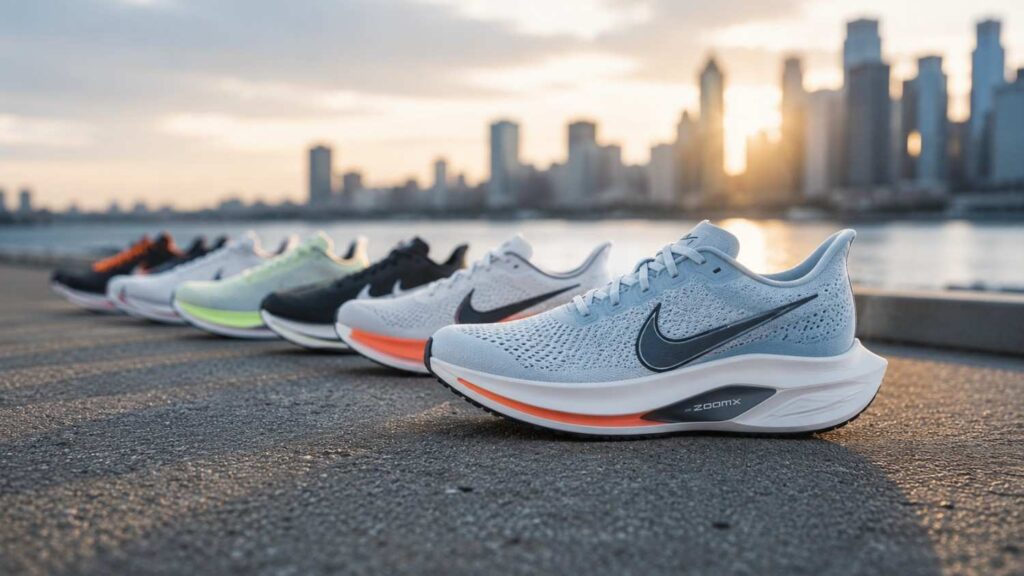
The Best Nike Running Shoes for 2026
Choosing the best Nike running shoes for 2026 can be confusing because the brand now offers several models with overlapping technologies. A daily trainer may use the same premium foam found in a faster shoe, while a modern stability model may feel softer and less corrective than traditional support footwear. The right choice therefore depends less on finding the shoe with the most technology and more on matching its design to your regular training.
Nike has simplified its core road-running range into three cushioning categories. Pegasus focuses on responsive cushioning, Vomero provides maximum cushioning, and Structure offers supportive cushioning. Dedicated speed models such as the Zoom Fly, Vaporfly, and Alphafly sit alongside those daily-training categories, while Nike’s renewed ACG range addresses trail running and outdoor performance.
In this guide, I compare the leading Nike running shoes by intended use, cushioning, support, plate construction, heel-to-toe drop, and practical versatility. The goal is not to name one universal winner. Instead, it is to help you identify which model best matches your experience level, weekly mileage, preferred terrain, and performance goals.
Product prices, colors, widths, and availability can differ between countries and may change during the year. Always confirm current specifications and regional availability through Nike or an authorized running retailer before placing an order.
How We Selected the Best Nike Running Shoes
A credible running-shoe comparison must consider more than marketing language or visual design. We evaluated each model according to its intended role, current construction, cushioning system, support features, weight category, heel-to-toe drop, and place within Nike’s broader lineup. We also considered whether a shoe offers enough versatility to justify its position in a typical runner’s rotation.
The recommendations are organized by use case because runners experience footwear differently. A lightweight athlete running fast road races may value a stiff carbon plate and minimal upper, while a beginner building consistency may benefit more from predictable cushioning, a comfortable fit, and durable traction. Neither preference is automatically superior.
We also distinguish between official technical claims and practical recommendations. Nike’s product pages provide information about foam, Air Zoom units, plate systems, weight, stack, and intended race distance. Those details help explain how each shoe is built. Our recommendations then translate those specifications into practical buying guidance.
Finally, the guide avoids assuming that a more expensive or technologically complex shoe is always better. A highly specialized racing shoe may perform exceptionally at speed but feel awkward during easy mileage. In contrast, a straightforward daily trainer may provide greater value because it works reliably across more sessions.
Official Technology and Intended Use
The first stage of selection involved reviewing Nike’s official description of each shoe. This matters because similar-looking models can be engineered for very different purposes. The Pegasus 42, for example, is positioned as an everyday responsive trainer. Its full-length Air Zoom unit and ReactX midsole aim to provide an energetic but controlled ride suitable for varied daily mileage.
The Vomero family takes a different approach. The Vomero Plus uses a full-length ZoomX midsole and a 45-millimeter heel stack to deliver a softer, more protective ride. The Vomero Premium extends that concept with a 55-millimeter heel stack and exposed Air Zoom units in both the forefoot and heel. Nike presents these shoes as maximum-cushioning options for high mileage, easy running, and recovery-focused training.
Structure models prioritize stability through geometry and a midfoot support system rather than relying solely on a rigid medial post. Nike’s racing shoes then combine ZoomX foam with carbon-fiber Flyplates, with the Alphafly adding forefoot Air Zoom units. Understanding these intended roles prevents unrealistic comparisons between daily trainers, recovery shoes, stability models, and race-day footwear.
Independent Testing and Practical Value
Official specifications describe construction, but they cannot determine whether a particular shoe will feel comfortable to every runner. Practical value depends on how those design choices interact with pace, body weight, running mechanics, foot shape, and personal preference. That is why a useful buying guide must interpret specifications instead of merely repeating them.
We gave greater weight to shoes that perform their stated role clearly. The Pegasus 42 earns a leading position because it can handle multiple types of everyday road running. The Vomero Plus stands out because it provides maximum cushioning without becoming as specialized or as heavy as the Vomero Premium. The Structure 26 offers a dependable option for runners who prefer stability, while the Structure Plus expands that category for runners who also want a softer super-foam sensation.
Value does not necessarily mean choosing the least expensive model. It means paying for features that support your actual training. A recreational runner who completes mostly easy 5K sessions may receive little benefit from an Alphafly 3. Conversely, a committed marathoner may consider a specialized racing shoe worthwhile if it has been tested successfully during long, race-pace workouts. The most valuable shoe is the one that gets used consistently for its intended purpose.
For broader perspective, expert running shoe testing from experienced gear reviewers can help validate how different models perform across a variety of running conditions and training goals.
Nike Running Shoes 2026 Comparison
The table below offers a direct comparison of the leading models in Nike’s 2026 running range. It should be treated as a starting point rather than a final prescription. Two runners can use the same shoe for different purposes, and personal comfort remains more important than a category label.
Heel-to-toe drop measures the difference between the height of the heel and forefoot. A higher drop generally places the heel farther above the forefoot, while a lower drop creates a flatter platform. This measurement does not independently determine whether a shoe is comfortable, stable, or suitable for a specific foot strike. Stack height, foam firmness, rocker geometry, platform width, and upper construction also influence the overall experience.
The “main consideration” column highlights the most important trade-off associated with each model. Maximum cushioning usually adds bulk and height. Racing shoes reduce weight but may sacrifice durability, stability, or comfort at slower paces. Stability shoes provide more guidance but can feel unnecessarily structured to runners who prefer flexible neutral footwear.
Specifications can vary slightly by size, gender-specific version, and regional product page. The weights listed by Nike are generally based on a men’s US size 10, so smaller or larger sizes will weigh differently. Always check the exact version you intend to purchase.
| Nike Running Shoe | Best For | Main Technology | Drop | Main Consideration |
|---|---|---|---|---|
| Pegasus 42 | Everyday road running | ReactX and full-length Air Zoom | 10 mm | Less plush than Vomero |
| Vomero Plus | Long and recovery runs | Full-length ZoomX | 10 mm | Tall, soft platform |
| Vomero Premium | Maximum-impact protection | ZoomX and dual Air Zoom units | 10 mm | Heavy and highly stacked |
| Structure 26 | Everyday stability | ReactX and midfoot support system | 10 mm | More controlled than a neutral trainer |
| Structure Plus | Cushioned stability | ZoomX, ReactX, and support system | 10 mm | More substantial underfoot |
| Zoom Fly 6 | Tempo and race training | ZoomX and carbon Flyplate | 8 mm | Plated ride may feel rigid at easy pace |
| Vaporfly 4 | 10K to marathon racing | ZoomX and carbon Flyplate | 6 mm | Lightweight, narrow, and race-focused |
| Alphafly 3 | Half-marathon and marathon racing | ZoomX, Air Zoom, and carbon Flyplate | 8 mm | Expensive and highly specialized |
| ACG Zegama Trail | Technical trail running | ZoomX, Cushlon 3.0, Vibram Megagrip | 4 mm | Heavier and more protective than road shoes |
The listed drops and technologies are based on current Nike product information.
Best Single-Pair Option
The Pegasus 42 is the best single-pair option for runners who want to simplify their footwear collection. It offers enough cushioning for routine road mileage without the extreme softness or height of Nike’s Vomero models. At the same time, its full-length Air Zoom unit gives it a more responsive character than a basic entry-level trainer.
A single-shoe solution should be comfortable during easy running but capable of handling occasional faster efforts. The Pegasus 42 meets that requirement more effectively than Nike’s specialized alternatives. You can use it for short recovery jogs, standard aerobic runs, treadmill training, moderate long runs, and controlled tempo sections. It is not as efficient at race pace as the Zoom Fly or Vaporfly, but it is easier to use across an entire week.
Nike also updated the forefoot shape and created additional room around the toes compared with the Pegasus 41. That change may improve comfort for runners who previously found the Pegasus restrictive, although it does not guarantee a wide-foot fit.
Choose a different model only when you have a clear priority, such as maximum softness, added stability, technical trail traction, or competitive racing performance.
Best Two-Shoe Rotation
A two-shoe rotation allows each pair to serve a clearer purpose. For many runners, the most useful combination is a dependable daily trainer paired with either a softer recovery shoe or a faster workout shoe. This creates meaningful variety without requiring an expensive collection of highly specialized footwear.
The Pegasus 42 and Vomero Plus form a balanced comfort-focused rotation. Use the Pegasus for routine mileage, steady running, and mixed-pace sessions. Save the Vomero Plus for long runs, recovery days, and periods when your legs feel particularly fatigued. The difference between responsive cushioning and maximum cushioning makes the two shoes complementary rather than redundant.
Runners focused on improving speed may prefer the Pegasus 42 and Zoom Fly 6. The Pegasus can manage easy mileage, while the Zoom Fly’s ZoomX foam and full-length carbon-fiber Flyplate provide a more propulsive platform for tempo runs, intervals, and race-pace workouts. Nike describes the Zoom Fly 6 as suitable for both race training and selected racing.
Stability runners can apply the same principle by pairing the Structure 26 with the Structure Plus. The Structure 26 provides firmer control, while the Plus offers greater softness for longer or easier sessions.
Related Articles
Best Nike Shoes for Daily Runs and Maximum Cushioning
Nike’s Pegasus and Vomero lines serve runners who primarily train on roads, but they create distinctly different sensations. Pegasus is designed around responsive cushioning and everyday versatility. Vomero prioritizes maximum cushioning, comfort, and protection from repeated impact. Understanding that distinction is essential when comparing the Nike Pegasus 42 vs Vomero Plus.
Responsive cushioning generally feels controlled, moderately firm, and adaptable across different paces. Maximum cushioning uses a greater volume of softer material to reduce harshness during easy or long-distance running. Neither approach is automatically better. Some runners feel more efficient in a moderately cushioned shoe, while others enjoy the comfort and rolling motion of a taller platform.
The Vomero Premium extends the maximum-cushioning concept further than the Vomero Plus. Its unusually tall stack and dual Air Zoom units create a highly protective experience, but the shoe is heavier and less naturally suited to quick directional changes or fast workouts. It is therefore important to separate “most cushioning” from “best all-around performance.”
Beginners should avoid assuming that maximum cushioning automatically prevents discomfort or injury. Comfort is useful, but training progression, appropriate workload, sleep, strength, and recovery habits remain important. The best Nike shoes for running are those that feel comfortable while matching the surfaces, speeds, and distances you complete regularly.
| Technology | Found In | Main Purpose | Ideal Running Style |
|---|---|---|---|
| ReactX Foam | Pegasus 42, Structure 26 | Responsive everyday cushioning | Daily training |
| ZoomX Foam | Vomero Plus, Vaporfly 4, Alphafly 3 | Lightweight energy return | Long runs and racing |
| Air Zoom Units | Pegasus 42, Alphafly 3 | Added responsiveness during stride | Road running and marathons |
| Carbon Flyplate | Zoom Fly 6, Vaporfly 4, Alphafly 3 | Forward propulsion and speed | Tempo runs and races |
| Midfoot Support System | Structure 26, Structure Plus | Stability and foot guidance | Overpronation support |
| Vibram Megagrip Outsole | ACG Zegama Trail | Superior traction on rugged terrain | Trail and mountain running |
Nike Pegasus 42 — Best Overall Daily Trainer
The Nike Pegasus 42 is the strongest daily trainer in this guide because it balances comfort, durability, responsiveness, and familiarity. Its ReactX foam midsole provides the main cushioning layer, while a curved, full-length Air Zoom unit adds a more energetic transition from landing to toe-off. Nike states that the updated Air Zoom system delivers greater energy return than the Pegasus 41.
The shoe works best for neutral runners who want predictable performance rather than an aggressively soft or highly rockered ride. Its 10-millimeter drop will feel familiar to many runners moving from conventional road trainers. High-abrasion rubber and the updated Waffle outsole are intended to provide traction and flexibility during consistent road use.
In practical terms, the Pegasus 42 is suitable for beginner training plans, regular 5K and 10K mileage, treadmill workouts, moderate long runs, and general fitness. More advanced runners can use it as a reliable easy-day shoe between plated workouts.
Its main limitation is that it does not dominate any single performance category. The Vomero Plus is softer, the Zoom Fly 6 is faster, and the Structure 26 is more supportive. The Pegasus succeeds because it performs all of those roles reasonably well without becoming overly specialized.
Nike Vomero Plus — Best for Long and Recovery Runs
The Nike Vomero Plus is designed for runners who want a softer, more protective daily experience. Its full-length ZoomX midsole provides a deeper and more responsive cushion than the ReactX platform used in the Pegasus 42. Nike lists a 45-millimeter heel stack, a wide base, increased rocker geometry, and a 10-millimeter heel-to-toe drop.
That combination makes the shoe particularly effective for long aerobic runs and recovery mileage. The tall foam stack helps reduce the harsh sensation of repeated road impact, while the rocker assists forward movement when your legs become tired. The broad platform is also important because soft foam without sufficient width can feel unstable.
The Vomero Plus is not limited to very slow running. ZoomX gives it enough energy to handle steady efforts and controlled progression runs. However, it remains less precise than a lower, firmer trainer when accelerating sharply or changing direction.
Choose the Vomero Plus when softness and long-distance comfort are higher priorities than ground feel. It can also work well for runners who spend significant time walking or standing, although that should not be confused with a medical recommendation. Runners who dislike tall platforms should try the Pegasus 42 or Vomero 18 before committing.
Nike Vomero Premium — Best for Maximum Cushioning
The Vomero Premium represents the most extreme expression of cushioning in Nike’s current road range. It combines a full ZoomX midsole with two exposed Air Zoom units, placing one unit in the heel and another in the forefoot. Nike gives the shoe a 55-millimeter heel stack, making it the tallest road-running model in the company’s lineup.
The current men’s product page lists an approximate weight of 351 grams in a US size 10 and a 10-millimeter drop. Those figures explain why the Vomero Premium should not be treated as a conventional speed shoe. Its purpose is to provide a soft, low-impact sensation during easy running, recovery sessions, and high-volume training periods.
The tall platform requires more awareness than a lower daily trainer. Runners should introduce it gradually, especially when cornering, running on uneven surfaces, or moving from a low-drop shoe. It may also feel excessive to lighter runners or those who prefer strong ground contact.
I recommend the Vomero Premium only when maximum cushioning is a deliberate priority. The Vomero Plus is more versatile for most runners, while the Premium is better suited to recovery-focused athletes who understand the trade-off between protection and weight.
Best Nike Stability and Speed-Training Shoes
Stability and speed training once appeared to require completely different types of footwear. Traditional stability shoes often used firm medial posts and rigid structures, while speed shoes emphasized minimal weight and flexible uppers. Nike’s current Structure and Zoom Fly models show how those categories have evolved.
The Structure 26 and Structure Plus rely on supportive geometry and a midfoot system that wraps the medial arch and lateral heel. This approach aims to guide the foot without creating the abrupt sensation associated with some older stability designs. The Structure 26 offers the firmer and more balanced experience, while the Structure Plus adds a softer combination of ZoomX and ReactX foams.
The Zoom Fly 6 addresses a different need. It is a plated shoe, but it is built with more substance than the Vaporfly or Alphafly. That makes it better suited to repeated tempo runs and race-pace workouts. It allows runners to train with a propulsive platform without using a lightweight race-day shoe for every demanding session.
These models should not be considered direct substitutes. Structure shoes prioritize confidence and controlled transitions. The Zoom Fly prioritizes efficient forward movement at faster paces. Runners who need support during speed sessions may prefer to complete most training in a Structure model and test the Zoom Fly carefully before adopting it for harder workouts.
Nike Structure 26 — Best Everyday Stability Shoe
The Nike Structure 26 is the most balanced stability option in the current Nike lineup. Its midfoot support system wraps the medial arch and lateral heel, creating guidance from both sides of the foot rather than relying on a single firm component under the arch. A full ReactX midsole supports smoother transitions while maintaining a controlled base.
Nike lists the men’s version at approximately 320 grams in a US size 10, with a 10-millimeter heel-to-toe drop. The upper includes additional padding around the collar and tongue, while durable rubber is placed in high-wear areas.
The Structure 26 is appropriate for runners who feel unstable in very soft neutral shoes, prefer a broader guided platform, or have previously been comfortable in stability footwear. It can handle daily mileage, long runs, walking, and general fitness without feeling as rigid as many traditional support models.
However, the Structure 26 should not be prescribed solely because a runner overpronates or has flat feet. Mild inward movement is a normal part of many running strides. The correct choice is the shoe that feels comfortable and stable during actual movement. Persistent pain or significant gait concerns should be discussed with a qualified healthcare professional.
Nike Structure Plus — Best Cushioned Stability Shoe
The Structure Plus is intended for runners who want the confidence of a stability shoe without giving up the soft, energetic sensation associated with premium foam. It places ZoomX above a ReactX carrier and uses the same midfoot support concept introduced in the Structure 26. Nike describes the Structure 26 as the firmer, more balanced model and the Structure Plus as the softer, more responsive alternative.
The men’s product page lists an approximate weight of 309 grams in a US size 10 and a 10-millimeter drop. Nike also gives the shoe a 42-millimeter heel stack and 32-millimeter forefoot stack. Wider geometry through the midfoot helps control the taller cushioning platform.
In a Nike Structure 26 vs Structure Plus comparison, choose the Structure 26 for a more traditional and controlled daily ride. Choose the Plus when long-run comfort, softness, and energy return are more important.
The Structure Plus may be more shoe than necessary for runners who already feel stable in neutral models. Its combination of support and high cushioning is most valuable when both features improve confidence. Try it at easy and moderate paces before assuming the more advanced foam automatically makes it the superior option.
Nike Zoom Fly 6 — Best for Tempo and Race Training
The Zoom Fly 6 fills the space between a daily trainer and an elite racing shoe. It uses ZoomX foam and a full-length carbon-fiber Flyplate, but its upper, outsole, and overall construction are more substantial than those of the Vaporfly 4. Nike lists an approximate weight of 265 grams in a men’s US size 10 and an 8-millimeter heel-to-toe drop.
This makes the Zoom Fly 6 well suited to tempo runs, threshold sessions, marathon-pace workouts, progression runs, and longer intervals. The plate helps create a more efficient rolling motion when pace increases, while the additional material makes the shoe practical for repeated training.
The Zoom Fly can also be used for racing, particularly by runners who prefer a more stable and durable platform. However, competitive athletes seeking minimum weight will usually prefer the Vaporfly or Alphafly.
One limitation is that plated shoes can feel stiff or unnatural during very slow running. The Zoom Fly 6 may therefore be unnecessary for recovery days. A sensible rotation pairs it with a Pegasus, Vomero, or Structure model so that the plated shoe is reserved for sessions where its geometry and responsiveness provide a meaningful benefit.
Best Nike Racing and Trail Running Shoes
Racing and trail running place very different demands on footwear. Road-racing shoes aim to minimize weight and improve forward efficiency on predictable surfaces. Trail shoes need to manage loose ground, rocks, roots, mud, steep gradients, and changes in direction. A shoe that performs exceptionally in one environment may be unsuitable in the other.
Nike’s current racing system combines ZoomX foam with a carbon-fiber Flyplate. The Vaporfly 4 offers the lighter and more versatile package, while the Alphafly 3 adds two forefoot Air Zoom units and a broader plate for marathon-focused propulsion and stability.
The ACG Zegama Trail follows a completely different design philosophy. Its foam system balances responsiveness with protection, while the Vibram Megagrip outsole and trail-specific geometry improve confidence on variable ground. It is heavier than a road racer because durability, grip, and underfoot protection matter more than saving every possible gram.
Before buying a specialized model, consider how frequently you will use it. A dedicated racing shoe can be worthwhile for goal events and key workouts, but it should not replace a comfortable daily trainer. Similarly, a technical trail shoe may feel inefficient on smooth roads. Matching the shoe to the surface remains more important than choosing the most advanced technology.
Nike Vaporfly 4 — Best Versatile Road Racing Shoe
The Nike Vaporfly 4 is the most versatile dedicated racing shoe in Nike’s lineup. It combines a full-length carbon-fiber Flyplate with ZoomX foam in a lightweight platform designed for road races from 10K through the marathon. Nike lists the men’s version at approximately 190 grams in a US size 10, with a 6-millimeter heel-to-toe drop.
Compared with the previous model, the Vaporfly 4 uses a higher plate angle and lower drop to create a more propulsive race-day position. Its engineered mesh upper is designed to reduce weight while maintaining containment. The shoe is most effective when the runner is moving purposefully and loading the plate with sufficient force.
The Vaporfly is not the ideal choice for daily training. Its minimal construction, race-focused fit, and premium foam are designed around performance rather than everyday durability. It may also feel narrow or unstable to runners who prefer a broad platform.
Choose the Vaporfly 4 when you want a lightweight Nike racing shoe that can cover several road distances. Test it during at least one quality workout before race day, paying close attention to heel security, forefoot comfort, and stability when turning.
Nike Alphafly 3 — Best Nike Marathon Racing Shoe
The Nike Alphafly 3 is the brand’s most specialized half-marathon and marathon racing model. Its performance system combines a full-length ZoomX midsole, a carbon-fiber Flyplate, and two Air Zoom units positioned beneath the forefoot. The continuous bottom design is intended to produce a smoother transition than earlier Alphafly versions.
Nike lists an approximate weight of 218 grams in a men’s US size 10 and an 8-millimeter heel-to-toe drop. The plate is wider than in the previous version, helping create a more stable platform around the highly responsive foam and Air units.
The Alphafly 3 feels more mechanically distinctive than the Vaporfly. Some runners enjoy its powerful forefoot sensation, while others prefer the lighter and more direct feel of the Vaporfly. Neither response is incorrect.
The Alphafly is best for runners who have already tested it during long workouts containing race-pace running. Do not introduce it for the first time on marathon morning. The upper, arch shape, plate stiffness, and Air Zoom sensation must remain comfortable after sustained use, not merely during a short test jog.
Nike ACG Zegama Trail — Best for Technical Trails
The ACG Zegama Trail is built for uneven, technical terrain where a road shoe would lack grip and protection. Its cushioning system combines responsive ZoomX foam with a stabilizing layer of Cushlon 3.0. A Vibram Megagrip outsole with Traction Lug technology provides traction across variable trail conditions. Nike lists a 4-millimeter heel-to-toe drop.
The difference between the Zegama and a road trainer becomes most noticeable on steep descents, loose surfaces, rocks, and roots. The trail-specific outsole provides more secure contact, while the protective construction helps reduce the harshness of uneven ground. A roomier forefoot can also accommodate the natural toe spread and swelling that occur during longer trail efforts.
The lower drop may require an adjustment period for runners accustomed to 10-millimeter road shoes. Begin with shorter, less technical routes before using the Zegama for a long mountain run.
It is also important to choose trail shoes according to local terrain. The Zegama is appropriate for demanding and mixed conditions, but runners using smooth gravel paths may prefer a lighter road-to-trail model. Technical protection is valuable only when the route actually requires it.
How to Choose the Right Nike Running Shoe
Choosing among the best Nike shoes for running becomes easier when you follow a consistent process. Begin with your regular training rather than an aspirational event. A runner who completes four easy road runs each week should prioritize a daily trainer, even if a marathon is planned several months later.
Next, identify your preferred underfoot sensation. Responsive shoes such as the Pegasus provide a controlled, energetic feel. Maximum-cushioning shoes such as the Vomero Plus feel deeper and softer. Structure models add guidance, while plated shoes create a stiffer and more rolling transition. These differences can be felt immediately, but they should also be tested at realistic running paces.
Fit deserves equal attention. The correct length does not guarantee that the width, heel hold, arch shape, or upper volume will suit your foot. Feet can also swell during long runs, so a shoe that feels perfect while standing may become restrictive after an hour.
Finally, resist choosing footwear based entirely on appearance, online popularity, or a professional athlete’s preference. Elite runners often use specialized shoes within carefully planned training systems. Your best choice may be a less dramatic model that keeps you comfortable and consistent. Comfort, confidence, and suitability for your actual workload should guide the final decision.
| Runner Profile | Recommended Nike Shoe | Primary Benefit | Best Running Environment |
|---|---|---|---|
| Beginner Runner | Pegasus 42 | Balanced cushioning and versatility | Road, treadmill, daily training |
| Long-Distance Runner | Vomero Plus | Maximum comfort for extended mileage | Road, recovery runs |
| Stability-Seeking Runner | Structure 26 | Guided support and smoother transitions | Daily road running |
| Speed Training Athlete | Zoom Fly 6 | Efficient energy return for faster sessions | Track and road workouts |
| Marathon Competitor | Alphafly 3 | Race-day propulsion and efficiency | Half & full marathon events |
| Technical Trail Runner | ACG Zegama Trail | Grip and protection on uneven terrain | Mountain and trail routes |
Step 1 — Match the Shoe to the Workout
Begin by writing down the sessions you complete during a normal week. If most of your running is easy or moderate road mileage, choose a daily trainer before considering a racing shoe. The Pegasus 42 is the broadest option for neutral runners, while the Structure 26 serves runners who prefer additional guidance.
For soft long runs and recovery days, consider the Vomero Plus. The Vomero Premium should be reserved for runners who deliberately want an unusually tall and cushioned platform. For tempo runs, intervals, and race-pace sessions, the Zoom Fly 6 offers a more training-oriented plated design.
Race shoes should be selected after the daily-training requirement has been solved. Choose the Vaporfly 4 for lightweight versatility across multiple road distances. Consider the Alphafly 3 when half-marathon or marathon performance is the main objective and its distinctive construction feels comfortable during long workouts.
Surface matters as much as pace. Road shoes are designed for pavement and predictable paths. For steep, rocky, muddy, or technical trails, choose a trail model such as the ACG Zegama. Using the correct outsole and protective construction can be more important than choosing the softest or lightest foam.
Step 2 — Check Fit, Width, and Comfort
Try running shoes with the socks you normally use, preferably later in the day when your feet may be slightly larger. Check that your toes can move naturally without sliding excessively. There should be enough space in front of the longest toe to accommodate movement and swelling, but not so much length that the heel lifts.
Evaluate width independently from length. Sizing up can create additional space, but it may also move the flex point, arch position, and heel structure away from the intended locations. Nike currently offers wide versions of selected models, including certain Vomero and Structure shoes, although availability varies by region and color.
Pay attention to pressure over the arch, irritation around the ankle, tightness across the forefoot, and movement through the heel. A racing shoe may fit more closely than a daily trainer, but it should not cause numbness or sharp discomfort.
Comfort should be assessed while moving. Walk, jog, accelerate briefly, and make several controlled turns. A shoe that feels soft while standing may become unstable during running, while a firm shoe may feel smoother once the midsole is properly loaded.
Step 3 — Test the Shoe Before Committing
A brief in-store test cannot reproduce a long run, but it can reveal obvious problems. Start by walking naturally, then jog at an easy pace. If space permits, increase to a moderate pace and complete several turns. Notice whether the shoe feels stable, whether your heel remains secure, and whether any part of the upper creates concentrated pressure.
When purchasing online, confirm the retailer’s current return policy before wearing the shoes outdoors. Keep the packaging intact and test the pair on a clean indoor surface where allowed. Return conditions vary, so do not assume that every retailer accepts footwear after an outdoor run.
Introduce a new shoe gradually, especially when its drop, stack height, plate stiffness, or support system differs from your current model. Begin with a shorter run rather than immediately using it for your longest weekly session.
Do not ignore persistent pain. A shoe may require a brief adjustment period, but sharp pain, numbness, or worsening symptoms are not normal signs that it needs to be “broken in.” Stop using the shoe and seek appropriate professional guidance when discomfort continues. Footwear can influence comfort, but it cannot diagnose or treat an underlying injury.
If you’re comparing multiple models before buying, independent running shoe reviews can provide additional insights into fit, durability, and real-world performance alongside your own testing.
Quick Answer About The Best Nike Running Shoes for 2026
The best Nike running shoes for 2026 depend on your training goal, preferred cushioning, support requirements, and running surface. For most neutral road runners, the Nike Pegasus 42 is the strongest all-around choice because it combines ReactX foam with a curved, full-length Air Zoom unit in a familiar daily-training package. Nike positions the Pegasus franchise around responsive cushioning, while Vomero represents maximum cushioning and Structure provides supportive cushioning.
Choose the Vomero Plus for soft long runs and recovery mileage, or the taller Vomero Premium when maximum impact protection matters more than speed. Runners who want additional guidance should compare the Structure 26 with the softer Structure Plus. For faster workouts, the Zoom Fly 6 offers a training-oriented carbon plate, while the Vaporfly 4 and Alphafly 3 are better reserved for racing. Trail runners should consider the ACG Zegama Trail for its combined ZoomX, Cushlon 3.0, and Vibram Megagrip system.
Best Overall Choice
For the widest range of runners, the Nike Pegasus 42 is the most practical starting point. It is neither the softest nor the lightest model in Nike’s lineup, but that balance is exactly what makes it useful. The shoe is designed for regular road running at varied paces, allowing it to handle easy morning miles, treadmill sessions, steady aerobic runs, and moderate progression workouts without feeling overly specialized.
The Pegasus 42 introduces a curved, full-length Air Zoom unit rather than the separate forefoot and heel units used in the previous model. It also retains a ReactX foam midsole and receives a more accommodating forefoot fit. According to Nike’s current product information, the men’s version has a 10-millimeter heel-to-toe drop and an approximate weight of 300 grams in a men’s US size 10.
Runners who want one dependable shoe instead of building a multi-pair rotation should begin here. However, those who strongly prefer soft cushioning may find the Vomero Plus more comfortable, while runners who need structured guidance may be better served by the Structure 26.
Best Choice by Running Goal
A useful way to choose between Nike running shoes is to identify the type of run you complete most often. If most of your weekly distance consists of standard road mileage, the Pegasus 42 provides the broadest versatility. If easy runs and long-distance comfort dominate your schedule, the Vomero Plus offers deeper, softer ZoomX cushioning and a wider platform.
Runners who feel more confident in a guided shoe should consider the Structure family. The Structure 26 delivers a comparatively balanced, controlled ride, while the Structure Plus adds more softness and responsiveness through its combination of ZoomX and ReactX foams. For faster sessions, the Zoom Fly 6 is more durable and training-friendly than Nike’s dedicated racing shoes.
Race-day choices should reflect distance and personal preference. The Vaporfly 4 is a lightweight option for road races from 10K through the marathon, whereas the Alphafly 3 is specifically tuned for half-marathon and marathon performance. On technical trails, the ACG Zegama Trail provides the protection and traction that road shoes cannot offer.
Frequently Asked Questions About
The following questions address the most common concerns runners have when comparing Nike’s current lineup. The answers are designed to provide a practical starting point, but individual fit and comfort can differ significantly.
New runners often focus on finding the single “best” model. More experienced runners tend to ask whether a shoe fits a particular role within a rotation. Both perspectives are useful. Beginners need a reliable and comfortable starting point, while advanced runners may benefit from separating easy mileage, faster training, racing, and trail running.
Technical terms should also be interpreted carefully. Maximum cushioning does not necessarily mean maximum stability. A carbon plate does not guarantee faster running for every athlete. A stability label does not mean that every runner with flat feet requires that model.
Whenever possible, compare at least two relevant shoes rather than testing one model in isolation. For example, a neutral runner can compare the Pegasus 42 with the Vomero Plus, while a runner seeking guidance can compare the Structure 26 with the Structure Plus. The contrast often makes personal preferences easier to recognize.
What are the best Nike running shoes for 2026?
The leading choices are the Pegasus 42 for everyday road running, Vomero Plus for cushioned long runs, Vomero Premium for maximum cushioning, Structure 26 for balanced stability, Structure Plus for softer stability, Zoom Fly 6 for faster training, Vaporfly 4 for versatile road racing, Alphafly 3 for half-marathons and marathons, and ACG Zegama Trail for technical terrain.
That list should be treated as a set of category winners rather than a universal ranking. The Pegasus 42 is the best overall recommendation because it addresses the broadest range of daily-training needs. However, it may not be the best personal choice for runners who strongly prefer soft cushioning, require additional guidance, or spend most of their time on trails.
The most reliable selection method is to identify your main training surface and most frequent workout. Then compare two shoes designed for that purpose. A daily trainer should feel comfortable at easy and moderate paces. A racing shoe should be tested at race pace. A trail shoe should be evaluated for traction, protection, and stability on terrain similar to your regular routes.
Is the Nike Pegasus 42 suitable for beginners?
Yes, the Nike Pegasus 42 is a strong beginner running shoe because it offers a familiar 10-millimeter drop, moderate cushioning, durable road traction, and enough versatility to support different types of introductory training. Its ReactX foam and full-length Air Zoom unit provide a responsive ride without the extreme height or stiffness found in more specialized models.
Beginners can use the Pegasus for run-walk sessions, easy continuous running, treadmill workouts, and gradually increasing weekly mileage. It can also remain useful as training becomes more structured, which means a new runner is less likely to outgrow it quickly.
However, beginners do not all need the same shoe. Someone who immediately prefers a softer sensation may be more comfortable in the Vomero Plus. A runner who feels unstable in neutral shoes may prefer the Structure 26. Comfort during movement should take priority over a general recommendation.
New runners should also increase distance gradually. Even the best Nike daily trainer cannot compensate for a sudden increase in workload. Consistent training, adequate recovery, and a comfortable fit matter more than purchasing the most advanced model.
Which Nike running shoe has the most cushioning?
The Vomero Premium has the tallest cushioning platform in Nike’s current road-running range. Nike gives it a 55-millimeter heel stack and combines a ZoomX midsole with exposed Air Zoom units in the heel and forefoot. The current men’s product listing identifies a 10-millimeter drop and an approximate weight of 351 grams in a US size 10.
That construction creates a highly cushioned experience intended for recovery mileage, easy runs, and high-volume training. However, the shoe’s height and weight make it less appropriate for fast cornering, short intervals, or runners who prefer direct ground contact.
The Vomero Plus is the more balanced maximum-cushioning option. It uses a full-length ZoomX midsole and a 45-millimeter heel stack, but it feels less extreme and is easier to use across a wider range of daily runs.
When comparing cushioned shoes, consider stability as well as softness. A very soft or tall platform may feel comfortable in a straight line but less secure during turns. The most cushioned shoe is not automatically the most suitable shoe for every runner.
Are Nike Structure shoes good for flat feet?
Nike Structure shoes can work well for some runners with flat feet, particularly when the runner prefers a guided platform and feels less stable in soft neutral footwear. The Structure 26 uses a midfoot support system that wraps the medial arch and lateral heel, while the Structure Plus combines that system with softer ZoomX and ReactX cushioning.
However, flat feet do not automatically require stability shoes. Foot shape and running mechanics are related but not identical. Some runners with low arches remain comfortable in neutral shoes, while others with higher arches may still prefer additional guidance.
The better approach is to test both a neutral and supportive option. Compare the Pegasus 42 or Vomero Plus with the Structure 26. Notice whether the Structure improves confidence and reduces unwanted movement without creating pressure beneath the arch.
Footwear should not be used as a substitute for medical assessment. If flat feet are associated with persistent pain, recurrent injuries, or difficulty walking and running comfortably, consult a podiatrist, physical therapist, sports-medicine professional, or another appropriately qualified clinician.
Is the Vaporfly 4 or Alphafly 3 better for a marathon?
The Vaporfly 4 and Alphafly 3 can both be used for marathon racing, but they create different experiences. The Vaporfly 4 is lighter, lower, and more versatile. Nike lists it at approximately 190 grams in a men’s US size 10 with a 6-millimeter drop. It may suit runners who want a direct, aggressive racing shoe that can also handle shorter road distances.
The Alphafly 3 is more specialized. It combines ZoomX foam, two forefoot Air Zoom units, and a wider carbon-fiber Flyplate. Nike positions it specifically for half-marathons and marathons and lists an approximate weight of 218 grams with an 8-millimeter drop.
Neither model is automatically faster for every runner. The Alphafly may provide a powerful rolling sensation, but its arch shape and Air Zoom units feel distinctive. The Vaporfly may feel more natural but less protective late in a marathon.
Complete long race-pace sessions in both models when possible. Choose the shoe that remains stable, comfortable, and efficient after sustained running rather than the one that feels most dramatic during a short test.
Can I use carbon-plated Nike shoes every day?
Carbon-plated Nike shoes can be used regularly, but the specific model matters. The Zoom Fly 6 is the most suitable option for repeated training because Nike designed it for speed runs, race preparation, and selected racing. Its upper, outsole, and overall construction are more substantial than those of Nike’s elite competition shoes.
The Vaporfly 4 and Alphafly 3 are more specialized. Their lightweight construction and aggressive geometry are intended to maximize race-day performance rather than provide a conventional experience during every easy run. Using them constantly may also increase replacement costs because premium racing shoes are expensive and generally less versatile than daily trainers.
A plate is not inherently harmful, but it changes how the shoe bends and how forces are transferred through the stride. Some runners feel comfortable in plated shoes immediately, while others experience calf, arch, ankle, or foot fatigue.
For most runners, a mixed rotation is more practical. Complete easy mileage in a Pegasus, Vomero, or Structure model. Use the Zoom Fly for demanding workouts and reserve the Vaporfly or Alphafly for selected sessions and races.
Conclusion
The best Nike running shoes for 2026 are not simply the models with the tallest cushioning, lightest weight, or most expensive technology. Each shoe is designed around a particular running experience. Pegasus emphasizes responsive daily cushioning, Vomero prioritizes maximum comfort, Structure provides guided support, and Nike’s plated models address faster training and racing.
For most runners, the buying process should begin with a daily trainer. A dependable everyday shoe will be used more frequently than a race-day model and will influence the quality of most weekly sessions. Once that requirement is met, specialized shoes can be added for recovery mileage, tempo workouts, races, or technical trails.
Fit remains the deciding factor. Technical specifications can narrow the options, but they cannot predict exactly how a shoe will interact with your foot. Compare relevant models, test them while moving, and pay attention to pressure, heel security, toe space, stability, and comfort at realistic paces.
A well-chosen running shoe should make training feel more natural, not force you to change your stride to accommodate the footwear. Focus on the model that supports consistent running and matches your actual goals rather than the one receiving the most attention online.
Final Recommendation
For neutral runners seeking one dependable shoe, the Nike Pegasus 42 is the best overall starting point. It offers a useful balance of cushioning, responsiveness, traction, and everyday versatility. It can support new runners as they build consistency and remain useful to experienced athletes who need a reliable daily trainer.
Choose the Vomero Plus when soft cushioning and long-distance comfort are more important than a traditional road feel. Consider the Vomero Premium only when you deliberately want the tallest and most protective option. Runners who prefer support should begin with the Structure 26, moving to the Structure Plus when additional softness and energy return are priorities.
For faster training, the Zoom Fly 6 is the most practical plated option. The Vaporfly 4 provides lightweight road-racing versatility, while the Alphafly 3 is the more specialized marathon choice. Trail runners tackling technical terrain should choose the ACG Zegama rather than attempting to use a road model off-road.
The final decision should reflect comfort and purpose. No ranking can replace testing the shoe on your own feet at the pace and distance you intend to run.
Next Step
Begin by identifying your primary use case: everyday road training, maximum-cushioning recovery, stability, speed work, road racing, or technical trail running. Select two models from the appropriate category and compare them directly rather than evaluating one shoe in isolation.
Wear your usual running socks and test both shoes at easy and moderate paces. Check the heel hold, forefoot width, arch pressure, transition, and stability. When shopping online, verify the current return policy and avoid outdoor use until you are confident that the shoe fits correctly.
After purchasing, introduce the shoe with a shorter run. This is particularly important when moving to a taller stack, lower drop, carbon plate, or unfamiliar support system. Gradual use gives your body time to adapt and reveals whether the shoe remains comfortable beyond the first few minutes.
Finally, record what you liked and disliked. Noting whether the shoe felt soft, firm, stable, narrow, heavy, or responsive will make future purchases easier. A small amount of structured comparison is more useful than choosing based solely on appearance or popularity.