
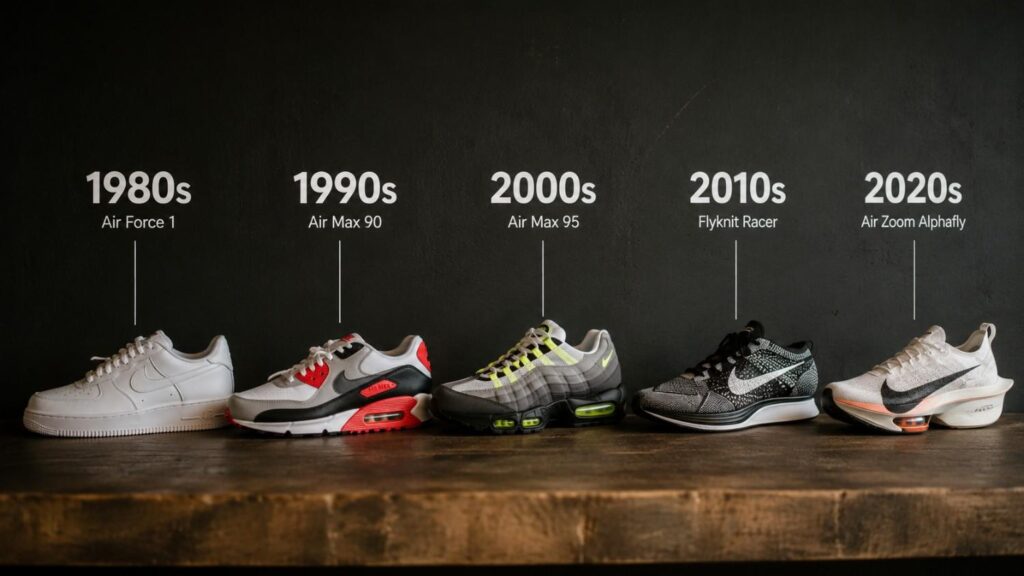
The Evolution of Nike Sneakers Over the Decade
Nike’s sneaker development during the last ten years cannot be explained simply by listing new models. The more meaningful story is how the company changed the role that technology, history, culture, performance, sustainability, and manufacturing play in modern footwear. Some of Nike’s most important products of this period introduced entirely new cushioning systems, while others revived designs created decades earlier and placed them back at the centre of contemporary sneaker culture.
For the purpose of this article, the evolution of Nike sneakers over the decade covers approximately 2016 through 2026. This period provides a useful window because it includes the rise of VaporMax, the growth of React and ZoomX cushioning, the expansion of carbon-plated racing shoes, the renewed popularity of the Dunk, the growing influence of SNKRS, and Nike’s recent experiments with Dynamic Air and additive manufacturing.
The decade also shows why sneaker innovation is no longer limited to making a shoe lighter or softer. Modern footwear can be designed around a specific racing distance, cultural audience, fashion movement, sustainability goal, or manufacturing process. At the same time, some of Nike’s most successful products prove that innovation can also involve reinterpreting an existing design rather than replacing it.
Looking at the full timeline allows us to see how these developments are connected and why Nike’s footwear strategy today is much broader than traditional sneaker design.
2016–2018: Cushioning Became the Centre of Sneaker Design
The early part of this decade marked an important shift in how Nike presented cushioning technology. Cushioning had always played a major role in the company’s footwear, particularly through Nike Air, but new products began to make the cushioning platform itself one of the most visually dominant parts of the shoe.
This period was not simply about increasing softness. Nike was exploring different ways to control energy return, responsiveness, weight, flexibility, and the relationship between the foot and the ground. VaporMax approached these goals through visible pressurized Air, while React introduced a new foam platform designed to balance multiple performance demands.
For broader historical context, this overview of Nike shoe evolution also shows how the brand’s designs developed across different eras.
These products also demonstrated two different design philosophies. VaporMax turned its Air unit into a visual feature that immediately distinguished the shoe from conventional midsoles. React, by contrast, placed greater emphasis on foam geometry and the overall ride. Both approaches influenced later Nike footwear because they established cushioning as something consumers could understand, compare, and actively look for.
The importance of this period therefore goes beyond two individual technologies. It helped create a sneaker market in which midsole compounds, Air units, foam density, energy return, and ride characteristics became part of mainstream product conversations. That development continues to shape performance and lifestyle footwear today.
VaporMax Reimagined Visible Nike Air
Nike introduced VaporMax commercially in 2017 after years of development, and the shoe represented a significant change in the history of visible Air. Traditional Air Max footwear generally placed Air cushioning within or alongside a foam midsole. VaporMax reduced that dependency by creating a system in which the Air unit could function much more directly beneath the foot.
According to Nike’s own history of the product, VaporMax was designed without the traditional foam midsole and conventional outsole construction found in many earlier Air models. Instead, the cushioning system used connected Air pods positioned to compress and rebound as the wearer moved. This gave the shoe a distinctive appearance while making its cushioning technology immediately visible.
The design continued an idea that had shaped Nike footwear since the Air Max 1 made part of its Air unit visible in 1987. VaporMax pushed that concept further by allowing the cushioning system to dominate the entire bottom of the shoe.
From a design perspective, this mattered because performance technology became part of the sneaker’s visual identity. Consumers did not need to read technical specifications to recognize that VaporMax worked differently from a conventional foam-based sneaker.
React Brought a Different Kind of Cushioning
While VaporMax emphasized visible Air, Nike React developed along a different path. The technology first appeared in basketball products before Nike introduced the Epic React Flyknit running shoe in 2018. The goal was to create a foam that could deliver softness, energy return, reduced weight, and durability without forcing designers to choose only one of those characteristics.
React was important because foam engineering was becoming increasingly competitive across the footwear industry. Consumers and athletes were paying more attention to how a shoe felt during repeated impact rather than judging it only by weight or appearance. Nike therefore needed a cushioning platform capable of serving different categories while still offering a recognizable ride.
The Epic React Flyknit also demonstrated how separate Nike technologies could work together. Its upper used Flyknit, Nike’s digitally engineered knitted construction, while the midsole relied on React foam. Combining these technologies helped reduce unnecessary material while giving designers greater control over flexibility and support.
React later became part of a broader cushioning family rather than remaining limited to one running shoe. Its significance lies in showing how material science, digital knitting, geometry, and performance testing increasingly became interconnected within Nike footwear development.
2017–2020: Vaporfly Changed Performance Running
The development of Nike Vaporfly became one of the most influential performance-footwear stories of the decade. Instead of focusing on cushioning alone, Vaporfly combined several design elements into one racing system: highly responsive foam, a stiff curved plate, lightweight construction, and a high-stack midsole.
The result created a new discussion around what a racing shoe could contribute to athletic performance. Running footwear had always mattered, but the Vaporfly era made shoe design a much more visible part of conversations about running economy, elite marathon times, and competition rules. Athletes, researchers, governing bodies, rival brands, and recreational runners all became interested in how modern racing shoes worked.
This period also accelerated competition across the running industry. Once carbon-plated racing technology became established, other footwear companies introduced their own approaches. The category developed rapidly, with designers experimenting with different foams, plate shapes, geometries, stack heights, and rocker profiles.
Importantly, the significance of Vaporfly should not be reduced to one number or one world record. Its wider impact was the creation of a new performance-footwear framework. Racing shoes were increasingly treated as engineered systems in which several components worked together. That idea influenced not only Nike’s future products but also the design direction of the broader running market.
ZoomX and Carbon-Plated Shoes Created a New Formula
Nike’s advanced racing shoes combined ZoomX foam with a rigid carbon-fiber plate placed inside the midsole. The foam provided a lightweight and highly responsive cushioning platform, while the plate and shoe geometry contributed to the overall mechanics of the ride. These elements worked together rather than functioning as independent features.
Research helped bring greater attention to the design. A peer-reviewed study published in 2018 examined a Nike racing-shoe prototype and reported an average reduction of around 4% in the energetic cost of running compared with the conventional racing shoes included in the study. This finding is often misunderstood. It did not mean that every athlete wearing the shoe would automatically run 4% faster. Running performance depends on numerous factors, including fitness, biomechanics, course conditions, pacing, and individual response.
Nevertheless, the research helped explain why advanced racing footwear became so important. Instead of simply reducing shoe weight, designers were changing how cushioning, stiffness, and geometry interacted during movement.
The broader effect was the emergence of the modern “super shoe” category. Carbon plates, high-performance foams, and aggressive midsole geometries became common features in elite racing shoes from multiple brands.
Running-Shoe Innovation Triggered New Regulations
The rapid development of racing footwear eventually created an unusual situation: technological progress became significant enough to influence the rules governing competition. World Athletics responded by modifying its shoe regulations in 2020, addressing issues such as sole thickness and the number and arrangement of rigid plates.
For applicable road-racing footwear, the rules introduced a maximum sole thickness of 40 millimetres and restrictions designed to prevent unlimited mechanical structures from being added inside the shoe. These regulations were important because they acknowledged that footwear could meaningfully influence competitive performance and therefore needed clearer boundaries.
The introduction of regulations did not stop innovation. Instead, it created a defined environment in which brands could continue developing racing shoes. Nike continued refining the Vaporfly franchise and introduced newer generations with changes to weight, upper design, geometry, and cushioning.
This relationship between innovation and regulation is a key part of the evolution of Nike sneakers over the decade. Few lifestyle sneakers ever become important enough to influence sporting regulations. Vaporfly demonstrated that modern footwear engineering can affect not only product design and consumer demand but also the competitive framework in which athletes perform.
2017–2021: Nike Sneakers Became Bigger Fashion and Culture Objects
Nike’s technical developments were only one part of the decade. At the same time, sneakers became increasingly important as cultural products connected with fashion, music, skateboarding, design, art, celebrity influence, and online communities.
Nike benefited from one of its greatest strengths: an extensive archive of recognizable silhouettes. Instead of depending entirely on new models, the company could return to older shoes and introduce them to audiences who may not have experienced the original releases. Collaborations, limited editions, storytelling, and carefully timed retro launches gave historical products new relevance.
This period also showed that the meaning of a sneaker can change dramatically over time. A shoe originally created for basketball might later become a skateboarding model, a streetwear symbol, or a fashion product. The Dunk is perhaps the clearest example, but the same pattern can be seen across Air Jordan, Air Max, Blazer, and other Nike franchises.
Collaborations added another layer. Rather than simply applying new colours to existing shoes, some designers reinterpreted the construction, materials, proportions, and visual language of Nike products. This encouraged consumers to look at familiar sneakers differently and expanded the role of footwear as a design object.
The cultural evolution of Nike sneakers therefore became just as important as advances in performance technology.
Virgil Abloh’s “The Ten” Changed Collaboration Language
Virgil Abloh’s Off-White collaboration with Nike became one of the most influential sneaker projects of the late 2010s. Known as “The Ten,” the project reworked ten established Nike and Converse silhouettes through a visual approach that deliberately exposed construction methods and challenged the idea that premium sneakers needed to look perfectly finished.
Abloh repositioned Swooshes, exposed foam around tongues, used visible stitching, added quotation-mark typography, incorporated plastic zip ties, and emphasized manufacturing details that would normally be hidden. The result made familiar products appear unfinished, reconstructed, or caught somewhere between prototype and final design.
The project mattered because it changed expectations surrounding sneaker collaborations. A collaboration no longer needed to rely primarily on colour changes or premium materials. Designers could question the original structure of a sneaker while still preserving enough recognizable elements for consumers to understand its history.
“The Ten” also connected Nike more directly with high fashion, contemporary design, and art-driven streetwear culture. Its influence can still be seen in later collaborations that expose construction, reinterpret proportions, or deliberately exaggerate technical elements.
The Dunk Returned From the Archives
The return of the Nike Dunk demonstrates how sneaker history can be reactivated for a new generation. The model originally appeared as a basketball shoe during the 1980s before becoming strongly associated with skateboarding through Nike SB. By the end of the 2010s and into 2020, the Dunk experienced another major shift, becoming one of the most visible lifestyle sneakers in fashion and streetwear.
Several factors contributed to the resurgence. Retro styling was becoming popular, collaborations generated fresh attention, and social media accelerated the visibility of limited releases. The Dunk’s relatively simple construction also made it easy to reinterpret through different colour combinations, materials, regional stories, and brand partnerships.
Its comeback showed that a sneaker does not need new cushioning technology to remain relevant. Cultural timing, history, scarcity, styling flexibility, and storytelling can sometimes be just as powerful.
The renewed popularity of Dunks also demonstrated the commercial value of Nike’s archive. Historical footwear could function as an active design resource rather than simply a record of the past, allowing old performance models to find completely new identities.
Supporting source: https://www.gq.com/story/nike-dunk-comeback
2020–2023: Sneaker Releases Became Increasingly Digital
The way consumers discovered and purchased Nike sneakers changed significantly during this period. Digital platforms had already become important before 2020, but their role expanded as sneaker launches, brand storytelling, member access, product education, and community engagement increasingly moved online.
Nike’s digital ecosystem allowed the company to communicate directly with consumers instead of relying exclusively on traditional retailers. Apps could provide product information, release calendars, exclusive access opportunities, personalized experiences, training content, and membership benefits within one connected system.
This shift was particularly important for limited footwear. Scarcity had long played a role in sneaker culture, but digital launches transformed the speed and scale at which information spread. A shoe could be previewed online, discussed globally, released through an app, and become part of resale-market conversations almost immediately.
Digital distribution also changed expectations. Consumers began to expect release alerts, product stories, high-quality imagery, early previews, and mobile access. The launch itself became part of the experience rather than simply the moment when a product appeared on a store shelf.
For Nike, this created both opportunities and challenges. Direct digital relationships offered more control over storytelling and consumer engagement, but highly demanded launches also produced frustration around availability, bots, limited stock, and unsuccessful purchase attempts. Even so, digital access became a permanent part of modern sneaker culture.
SNKRS Became More Than a Release Calendar
The Nike SNKRS app became an important part of the company’s relationship with sneaker enthusiasts because it developed beyond a basic list of release dates. The platform combined product launches with storytelling, member experiences, editorial content, early access opportunities, and previews of upcoming footwear.
This approach changed the way consumers interacted with sneaker releases. Instead of discovering a product only when it arrived at a retailer, users could follow its background, design inspiration, launch date, images, and availability through one branded environment. That allowed Nike to control more of the narrative surrounding important products.
SNKRS also became part of Nike’s broader membership ecosystem alongside Nike Run Club, Nike Training Club, and other digital services. This connected footwear purchasing with training, community participation, product discovery, and brand membership.
More recently, Nike has used SNKRS Showcases to preview large groups of upcoming releases. These presentations make the platform function partly as a digital exhibition space where consumers can see how future retro releases, lifestyle products, and technical footwear fit into Nike’s wider direction.
Retro and New Design Began Existing Side by Side
One of the most interesting effects of digital sneaker culture is that products from completely different design eras now compete for attention at the same time. A consumer opening a Nike app may see a retro basketball sneaker designed decades ago beside a technically advanced running shoe created using modern foam, data, and computational tools.
This coexistence changed the meaning of footwear progress. Nike no longer has to retire an old silhouette simply because a newer model exists. Instead, historical products can remain commercially relevant while technical innovation continues elsewhere in the portfolio.
Air Max, Foamposite, Dunk, Air Force 1, and other archival designs can therefore appear alongside current performance technologies without necessarily competing for the same consumer need. One product may appeal through nostalgia, cultural significance, or styling, while another is designed around running efficiency or advanced cushioning.
This layered product strategy is important for understanding Nike sneaker evolution. The company has learned to move forward without abandoning its past. New technology and historical design can operate simultaneously, giving consumers multiple reasons to engage with the brand.
Related Articles
2020–2024: Sustainability Entered Footwear Engineering
Sustainability became an increasingly visible part of Nike’s footwear strategy during the first half of the 2020s. The most useful way to evaluate this development is to separate measurable changes in manufacturing and materials from broad environmental marketing language.
Footwear is difficult to redesign from a sustainability perspective because a modern sneaker may contain foam, rubber, textiles, adhesives, plastics, reinforcement structures, and decorative components. These materials need to deliver durability, comfort, flexibility, traction, and performance while still being manufacturable at large scale. Improving one factor can create trade-offs elsewhere.
Nike’s recent approach has therefore included several different areas rather than one single solution. These include lower-impact manufacturing processes, recycled materials, refurbishment programs, footwear collection, waste-reduction initiatives, and changes to cushioning compounds.
ReactX provides an important example because Nike linked a performance technology with a manufacturing-impact claim. Instead of presenting sustainability as an entirely separate category, the company attempted to integrate it into the development of a running foam.
This does not mean every Nike shoe became environmentally sustainable during the decade. Such a claim would be too broad. The more accurate conclusion is that environmental impact increasingly became one of the variables considered alongside comfort, performance, weight, durability, and manufacturing efficiency.
ReactX Connected Performance With Carbon Reduction
Nike introduced ReactX foam commercially through the InfinityRN 4 in 2023. The technology was presented as an evolution of the original React platform, with the company focusing on both performance characteristics and the carbon impact associated with manufacturing the midsole.
Nike stated that the manufacturing process used for ReactX reduces the carbon footprint of a pair of midsoles by at least 43% compared with its previous React foam. The company also reported approximately 13% greater energy return. These numbers should be presented carefully because they are Nike’s own measurements relating to a specific comparison rather than universal claims about the environmental impact of the entire shoe.
The importance of ReactX is therefore not simply that one percentage became lower and another became higher. It represents a broader change in design priorities. Performance materials are increasingly being evaluated not only by how they feel underfoot but also by how they are produced.
For consumers, this creates a more complex definition of footwear innovation. A new material can be judged on responsiveness, comfort, weight, durability, manufacturing emissions, and scalability at the same time.
Circularity Became Part of Nike’s Broader Footwear Strategy
Nike has also developed programs designed to address products and materials beyond the initial manufacturing stage. Initiatives such as Nike Grind, Recycling & Donation, and Nike Refurbished reflect attempts to reduce waste, recover usable materials, extend product life, or create additional value from footwear that might otherwise be discarded.
Circularity is difficult in sneakers because many shoes are made from several materials permanently bonded together. Separating foam, rubber, textiles, plastic structures, and adhesives can be challenging and costly. As a result, circular footwear design requires changes not only in recycling but also in how products are originally engineered.
Nike Grind has historically used manufacturing waste and recovered materials in different applications, while refurbishment programs can extend the usable life of selected products. Donation and recycling initiatives provide additional pathways for certain footwear after consumers no longer need it.
These programs should not be interpreted as proof that Nike has solved footwear waste. Instead, they demonstrate how the evolution of Nike sneakers over the decade increasingly involves product life cycles as well as product launches. The conversation now includes what happens before, during, and after a sneaker’s main period of use.
Nike Footwear Technologies and Their Design Focus
| Nike Technology | Main Period | Core Design Focus | Key Characteristic | Notable Nike Footwear |
|---|---|---|---|---|
| VaporMax Air | 2017 onward | Air cushioning | Full-length Air system with a more direct connection between foot and Air platform | Nike Air VaporMax |
| React Foam | 2017–2018 onward | Responsive cushioning | Foam platform designed for softness, responsiveness, and durability | Epic React Flyknit |
| ZoomX | 2017 onward | Performance running | Lightweight, highly responsive cushioning used in advanced racing footwear | Vaporfly |
| Carbon-Fiber Plate | 2017 onward | Running efficiency | Rigid curved plate integrated with responsive cushioning | Vaporfly |
| ReactX | 2023 onward | Cushioning and material efficiency | Foam technology developed with a lower manufacturing carbon-footprint claim | InfinityRN 4 |
| Dynamic Air | 2024 onward | Adaptive Air cushioning | Dual chambers and multiple tubes designed to allow air movement during the footstrike | Air Max Dn |
| 3D-Printed Air | 2024–2025 onward | Additive footwear manufacturing | Digital manufacturing approach for creating complex footwear structures | Air Max 1000, Air Max 95000 |
2024–2026: Dynamic Air and 3D Printing Point Toward the Next Era
The most recent stage of Nike’s sneaker development suggests that the next decade may involve changes not only in cushioning materials but also in how footwear is constructed and manufactured. Dynamic Air and additive manufacturing represent two different approaches to that challenge.
Dynamic Air continues Nike’s long-running experimentation with pressurized cushioning, but instead of simply increasing the size of an Air unit, it changes how air moves inside the system. This gives designers another way to tune the transition from heel to toe and create a recognizable underfoot experience.
3D printing represents a more fundamental manufacturing shift. Traditional sneakers are usually assembled from multiple cut, stitched, molded, knitted, glued, or bonded components. Additive manufacturing can build complex structures layer by layer, potentially reducing the need for some conventional tooling and assembly processes.
However, these technologies should still be viewed as developing areas rather than proof that traditional sneaker manufacturing is about to disappear. Scaling new processes requires improvements in speed, durability, cost, consistency, material choice, repairability, and consumer acceptance.
Even with those limitations, these projects provide a useful indication of Nike’s direction. The company is exploring footwear as an engineered structure in which materials, geometry, cushioning, manufacturing, and digital design can increasingly be developed together.
Air Max Dn Introduced Dynamic Air
Nike introduced the Air Max Dn in 2024 with a cushioning system known as Dynamic Air. Instead of using one uniform Air chamber, the design contains multiple tubes arranged within two pressurized chambers.
Nike explains that the rear section operates at a higher pressure while the front section uses lower pressure. As the wearer moves through each step, air can shift within the chambers, creating a transition intended to feel dynamic rather than static. This approach differs from simply increasing the volume of visible Air.
The Air Max Dn is important within the broader Nike Air Max evolution because it demonstrates how the company continues to reinterpret a technology that has existed for decades. Visible Air began as a way to expose cushioning inside the midsole. Over time, Air units became larger, more complex, and more integrated into the shape of the shoe.
Dynamic Air represents the next stage of that progression by focusing on how pressure behaves within the cushioning unit. It treats the Air system less like one soft container and more like a mechanically tuned platform.
Official source: https://about.nike.com/en/newsroom/releases/nike-air-max-dn-official-images
3D Printing Could Change How Sneakers Are Developed
Nike’s work with 3D-printed footwear points toward a potentially significant change in product development. The Air Max 1000, created in collaboration with Zellerfeld, demonstrated how an Air Max-inspired shoe could be produced using additive manufacturing rather than relying entirely on conventional cut-and-sew construction.
Nike later revealed the Air Max 95000, a model inspired by the Air Max 95 and produced using its Project Nectar manufacturing process. These projects show that 3D printing is moving from experimental prototypes toward more visible footwear applications.
The potential advantages are significant. Additive manufacturing can create complex shapes that are difficult to achieve using traditional molds. Designers may also be able to adjust structures digitally, create different zones of flexibility, reduce the number of separate components, and test new forms more quickly.
However, widespread adoption will depend on practical factors such as production speed, cost, durability, comfort, material recyclability, and scalability.
For now, Nike 3D-printed shoes are best understood as evidence of an emerging manufacturing direction rather than a complete replacement for traditional sneaker production.
Nike Sneaker Evolution Timeline: What Changed Most?
Looking at the decade as a timeline makes one point especially clear: there was no single innovation responsible for Nike’s development. Several changes were happening in parallel.
Performance running moved toward highly specialized racing footwear. Air technology became more structurally complex. Foam engineering advanced through React, ZoomX, and ReactX. Heritage models returned through collaborations and retro releases. Digital platforms became increasingly important to product discovery and access. Sustainability entered material-development discussions, while 3D printing opened new possibilities for manufacturing.
A year-by-year look at Nike sneaker history helps put these technological and cultural shifts into a wider timeline.
This matters because sneaker evolution is often described too simply. A timeline of model names does not explain why those products were important. The more useful question is what each product changed.
VaporMax changed the relationship between visible Air and traditional midsoles. Vaporfly changed expectations around racing-shoe efficiency. The Dunk resurgence showed the value of archives and cultural timing. ReactX connected performance-material development with a manufacturing-carbon claim. Dynamic Air changed how pressurized cushioning could be configured. Additive manufacturing challenged assumptions about how a sneaker needs to be assembled.
The table below summarizes those developments and shows how different categories of innovation contributed to Nike’s overall direction.
| Period | Major Development | Why It Mattered |
|---|---|---|
| 2017 | VaporMax | Made an almost standalone Air system central to the shoe’s design and identity. |
| 2017–2018 | React | Expanded responsive foam cushioning across running and other categories. |
| 2017 onward | Vaporfly | Helped establish the modern advanced racing-shoe formula. |
| 2017 | Off-White “The Ten” | Reinterpreted classic Nike footwear through deconstructed design. |
| 2019–2020 | Dunk resurgence | Demonstrated the renewed cultural and commercial power of Nike’s archives. |
| 2023 | ReactX | Linked cushioning development with a lower manufacturing-carbon claim. |
| 2024 | Air Max Dn | Introduced Nike’s dual-chamber Dynamic Air approach. |
| 2024–2025 | 3D-printed Air Max | Explored additive manufacturing as a future footwear-production method. |
The Biggest Change Was Specialization
Perhaps the most important long-term change in Nike footwear is the degree of specialization now built into different sneaker categories. Nike has always produced footwear for different sports, but modern product development increasingly focuses on highly specific experiences and performance goals.
A Vaporfly is engineered around efficient road racing. A Pegasus is intended for more general running use. A Dunk may be purchased primarily for everyday style and cultural relevance. An Air Max Dn uses cushioning technology as part of both comfort and visual identity. These shoes do not need to solve the same problem.
This specialization also affects how consumers should compare products. Asking whether one Nike sneaker is “better” than another can be meaningless if the shoes were designed for different purposes. A racing shoe may prioritize lightweight responsiveness over long-term durability, while a lifestyle model may prioritize styling and everyday comfort.
The decade therefore represents a move away from universal sneaker design. Nike increasingly builds products around specific users, sports, surfaces, movements, cultural communities, and aesthetic preferences. That makes understanding intended use more important than simply choosing the newest technology.
How to Evaluate Any Nike Sneaker From This Period
The easiest way to evaluate a Nike sneaker from this decade is to examine four areas: purpose, cushioning, construction, and context. These factors provide a clearer understanding than focusing only on release date or popularity.
First, identify the shoe’s intended purpose. A racing model, basketball sneaker, training shoe, and lifestyle release are built around different priorities. Second, examine the cushioning platform. Technologies such as Air, ZoomX, React, ReactX, and Dynamic Air behave differently and should be judged according to the activity for which they were designed.
Third, look at construction. The upper may use traditional mesh, Flyknit, engineered textiles, synthetic materials, or additive manufacturing. Plates, outsole geometry, heel structure, and midsole shape can also influence performance and comfort.
Finally, consider cultural context. Some Nike products are important because they introduced major technical changes, while others matter because of collaborations, historical significance, limited releases, or fashion influence.
Using these four areas prevents the common mistake of assuming that every newer shoe is automatically superior. Evolution often means greater specialization rather than simple replacement.
Quick Answer About The Evolution of Nike Sneakers Over the Decade
The evolution of Nike sneakers over the decade reflects a shift from traditional footwear updates toward deeper changes in cushioning, performance engineering, cultural storytelling, sustainability, digital distribution, and manufacturing. From around 2016 to 2026, Nike introduced or expanded several major technologies, including VaporMax, React, ZoomX, ReactX, and Dynamic Air. At the same time, models such as the Dunk returned to mainstream fashion, while collaborations helped older silhouettes reach new audiences.
Nike also played an important role in the growth of carbon-plated performance running shoes through the Vaporfly series. More recently, the company has experimented with additive manufacturing and 3D-printed Air Max concepts.
What makes this period particularly important is that Nike did not evolve in only one direction. Performance footwear became more specialized, heritage sneakers became culturally relevant again, and digital platforms such as SNKRS changed how limited products were introduced to consumers. The result is a decade in which technology, history, fashion, sport, and manufacturing increasingly became connected parts of Nike’s footwear strategy.
Frequently Asked Questions About The Evolution of Nike Sneakers Over the Decade
Interest in Nike footwear history usually goes beyond identifying release dates. Readers also want to understand why particular technologies mattered, how old models became popular again, and whether newer manufacturing methods represent genuine innovation or simply different styling.
The questions below address the most common informational topics connected with Nike sneaker evolution. They focus on historical context, technology, culture, and product development rather than short promotional answers.
A useful pattern appears across these questions. Nike’s progress over the last decade has not followed one straight line. Some products advanced athletic performance, while others transformed fashion or digital sneaker culture. Certain innovations introduced new materials or cushioning systems, while others demonstrated how an older design could be repositioned for contemporary consumers.
Understanding these distinctions is valuable because modern sneakers are often discussed as though every release serves the same purpose. In reality, a Vaporfly should be evaluated very differently from a Dunk or Air Max lifestyle model. The following answers provide that context while also addressing common People Also Ask-style searches.
How Have Nike Sneakers Changed Over the Last Decade?
Nike sneakers have changed through deeper specialization, new cushioning technologies, digital distribution, renewed interest in heritage models, and new manufacturing methods. VaporMax expanded the role of visible Air, while React and ReactX developed foam-based cushioning in different directions. Vaporfly helped popularize carbon-plated racing footwear and influenced the broader performance-running market.
At the same time, Nike’s archive became increasingly important. The Dunk returned to mainstream fashion, and major collaborations reinterpreted historical products for new audiences. Digital platforms such as SNKRS changed how limited releases were introduced, explained, and distributed.
More recently, Nike has explored Dynamic Air and additive manufacturing. These developments show that the evolution of Nike sneakers over the decade is not simply about changing appearance. It includes material science, biomechanics, digital commerce, cultural storytelling, environmental considerations, and manufacturing.
The biggest overall change is that different Nike shoes now serve increasingly specialized roles rather than following one universal design philosophy.
When Was Nike VaporMax Introduced?
Nike VaporMax was commercially introduced in 2017 after a lengthy development process. The shoe became important because it rethought how visible Air cushioning could function within a sneaker.
Earlier Nike Air Max models typically used Air units in combination with a conventional foam midsole. VaporMax reduced that dependency by placing the foot much more directly over a system of Air pods. Nike describes the design as removing the traditional foam midsole and much of the conventional outsole structure associated with earlier constructions.
The result gave VaporMax an appearance that immediately communicated its technology. Instead of hiding the cushioning material inside a midsole, the Air system became one of the most recognizable visual elements of the shoe.
This made VaporMax significant beyond its launch year. It represented another stage in Nike’s long-term effort to turn performance technology into visible design. The concept continued the tradition established by earlier Air Max models while pushing the idea of exposed cushioning much further.
Official source: https://www.nike.com/a/vapormax-history/
Why Was Nike Vaporfly So Important?
Nike Vaporfly became important because it helped redefine expectations for racing-shoe performance. The shoe combined lightweight ZoomX foam, a carbon-fiber plate, substantial midsole thickness, and a geometry designed to work as one integrated system.
Scientific research contributed to the attention around the technology. A peer-reviewed study involving a Nike prototype reported roughly a 4% average reduction in running energetic cost compared with the conventional racing shoes used in the research. This does not mean all runners become 4% faster, but it helped demonstrate that footwear construction could influence running efficiency in measurable ways.
Vaporfly’s broader influence may be even more important than the performance of one model. Competing footwear brands began developing their own high-stack, plated racing shoes, creating the modern super-shoe category.
The technology also contributed to regulatory discussion. World Athletics introduced competition-shoe rules addressing sole thickness and plate structures, showing how seriously advanced footwear was being treated within elite sport.
Why Did Nike Dunks Become Popular Again?
The Nike Dunk became popular again because several cultural trends converged at the right time. Retro basketball footwear was returning to fashion, skateboarding remained closely connected to sneaker culture, collaborations generated attention, and social media made limited releases more visible than ever.
The Dunk also has a relatively simple and recognizable design, which makes it suitable for repeated reinterpretation. Different colourways, materials, collaborations, regional releases, and Nike SB editions can create distinct identities without changing the basic silhouette.
Another important factor is history. Because the Dunk has connections with basketball, college colour schemes, skateboarding, streetwear, and limited-edition sneaker culture, different audiences can attach different meanings to the same model.
Its resurgence demonstrates that sneaker innovation does not always require new technology. Sometimes cultural timing, archive management, storytelling, and scarcity can be equally powerful.
The Dunk’s return is therefore one of the clearest examples of Nike using its historical catalogue as an active source of contemporary product relevance.
What Is Nike ReactX?
Nike ReactX is a newer foam cushioning platform introduced commercially through the InfinityRN 4 in 2023. It builds on the earlier React cushioning system while aiming to improve energy return and reduce the carbon footprint associated with midsole manufacturing.
Nike reports that ReactX provides approximately 13% more energy return than its previous React foam. The company also states that the manufacturing process reduces the carbon footprint of a pair of midsoles by at least 43% compared with the earlier React production process.
These figures should be understood in their proper context. They relate to Nike’s comparison of the foam and manufacturing process rather than proving that an entire ReactX shoe has 43% lower environmental impact.
ReactX is important because it illustrates how footwear innovation is being evaluated through more than performance alone. Cushioning can now be assessed according to comfort, responsiveness, manufacturing efficiency, material properties, and environmental impact.
Official source: https://about.nike.com/en/newsroom/releases/nike-reactx-foam-infinity-rn-4-official-images
Is Nike Using 3D Printing for Sneakers?
Yes. Nike has explored additive manufacturing through projects including the Air Max 1000 with Zellerfeld and the later Air Max 95000. These products demonstrate how 3D printing can be used to create footwear structures that would be difficult to reproduce through traditional cut-and-sew or molded construction.
Additive manufacturing builds a form layer by layer from a digital design. This approach can potentially allow designers to create complex geometries, adjust flexibility in specific areas, reduce component counts, and experiment with prototypes more quickly.
However, 3D printing should not yet be viewed as a complete replacement for traditional sneaker manufacturing. Large-scale footwear production requires consistent quality, appropriate materials, fast production times, comfort, durability, and competitive costs. Those requirements can make new production methods difficult to scale.
Nike’s recent projects are therefore most useful as indicators of future potential. They show that sneaker innovation is expanding beyond cushioning and uppers into the manufacturing process itself.
Official source: https://about.nike.com/en/newsroom/releases/nike-sneaker-culture-complexcon/Nike-Air-Max-1000
Conclusion: What the Last Decade Tells Us About Nike Sneakers
The evolution of Nike sneakers over the decade shows that footwear innovation now operates across several areas at the same time. Nike has continued developing performance technology, but it has also become more sophisticated in the way it uses historical products, collaborations, digital platforms, sustainability initiatives, and experimental manufacturing.
VaporMax demonstrated how visible Air could become the structural and visual centre of a sneaker. React introduced another generation of foam cushioning, while Vaporfly helped accelerate the super-shoe era in performance running. The return of the Dunk proved that older silhouettes could become commercially and culturally important again when placed in the right context.
During the 2020s, Nike’s strategy expanded further. SNKRS strengthened direct digital relationships with sneaker consumers. ReactX connected performance-material development with a measurable manufacturing-carbon claim. Dynamic Air introduced another approach to pressurized cushioning, while 3D-printed Air Max projects suggested new ways footwear could eventually be manufactured.
What makes this decade especially important is that these developments did not replace one another. Retro sneakers remained relevant while advanced running technology moved forward. Air cushioning continued evolving alongside new foam systems. Physical products became increasingly connected with digital storytelling and distribution.
What This Evolution Means for the Future
The next stage of Nike footwear is likely to involve greater integration between digital design, material science, athlete data, manufacturing methods, and increasingly specialized performance requirements. Advances in computational design and additive manufacturing may allow engineers to create structures that would have been difficult or impossible to produce using traditional methods.
At the same time, Nike’s archive will probably remain highly relevant. Historical products such as Air Max, Dunk, Air Force 1, and other established silhouettes provide recognizable design foundations that can be updated through new materials, collaborations, and manufacturing techniques.
Consumers should therefore expect Nike’s future development to move in two directions at once. Some products will push performance and manufacturing technology forward, while others will reinterpret historical footwear for new cultural moments.
That balance may be one of Nike’s greatest advantages. The company does not have to choose between innovation and heritage. Its strongest strategy is often to preserve the cultural value of older sneakers while continuing to experiment with what footwear can become next.