
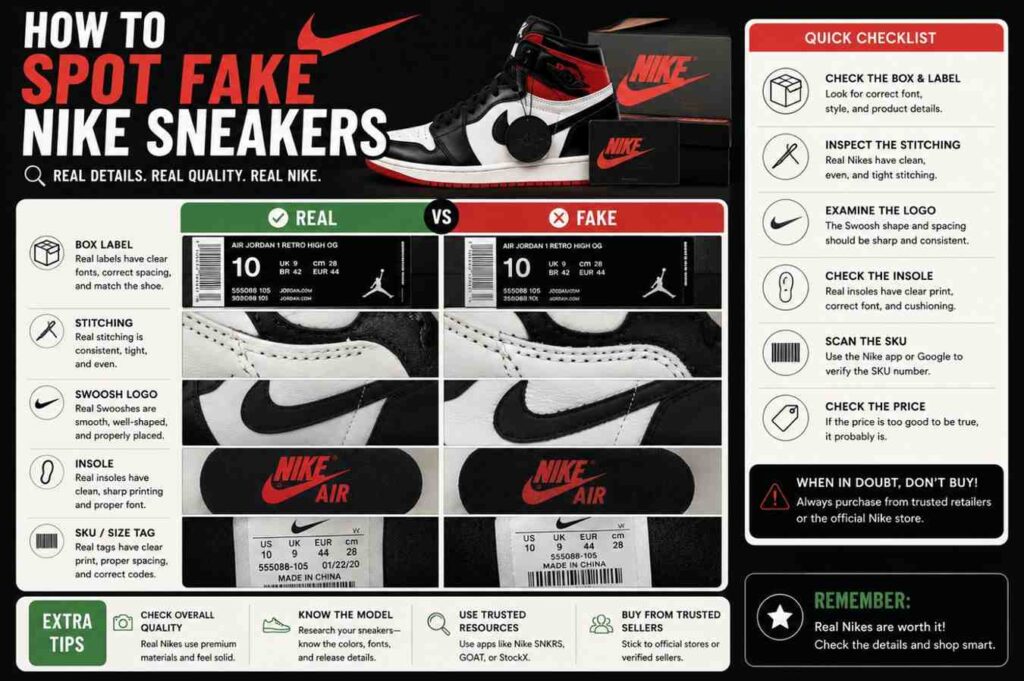
How to Spot Fake Nike Sneakers
Learning how to spot fake Nike sneakers is essential for anyone who buys athletic footwear online, shops through resale marketplaces, or collects limited-edition releases. Counterfeit sneaker production has become increasingly sophisticated, making it more difficult than ever to distinguish fake products from authentic ones. As a result, buyers must rely on careful inspection rather than assumptions based on appearance alone.
Fake Nike sneakers often imitate the overall design of genuine models but usually fall short in areas such as materials, craftsmanship, packaging, and quality control. Small details like uneven stitching, incorrect logos, poor-quality printing, or inaccurate product labels can reveal that a pair is not authentic. Understanding these warning signs can help consumers avoid costly mistakes and protect their investment.
Authentic Nike sneakers undergo strict manufacturing and quality assurance processes before reaching the market. Counterfeit versions, on the other hand, are typically produced with lower-quality materials and less attention to detail in order to reduce production costs. While some fake pairs may look convincing at first glance, a closer inspection often exposes noticeable differences in comfort, durability, and construction.
Whether you are purchasing from an online retailer, a resale platform, or a local seller, taking the time to verify authenticity is crucial. By learning how to examine product details, packaging, serial numbers, and overall build quality, you can significantly reduce the risk of purchasing counterfeit Nike sneakers and ensure that you receive a genuine product that meets the brand’s quality standards.
Why Fake Nike Sneakers Are So Common
Counterfeit footwear has become a global issue, and Nike is one of the brands most frequently targeted by counterfeit manufacturers. As one of the most recognizable athletic footwear companies in the world, Nike enjoys enormous popularity among athletes, sneaker enthusiasts, fashion-conscious consumers, and collectors. This widespread demand creates an attractive opportunity for counterfeit sellers who attempt to profit by producing imitation products that resemble genuine Nike sneakers.
Over the years, the counterfeit sneaker industry has evolved significantly. Modern fake Nike shoes are often manufactured with increasingly sophisticated techniques, making them much harder to identify than low-quality replicas from the past. Some counterfeit products can appear convincing at first glance, especially when sold through online marketplaces where buyers cannot physically inspect the shoes before purchasing.
Understanding why counterfeit Nike sneakers are so common is the first step toward protecting yourself from fraud. By recognizing the market factors that drive counterfeit production and learning how fake products have improved over time, consumers can become more cautious when shopping online or through resale platforms. The following sections explain the primary reasons counterfeit Nike shoes continue to flood the market and why careful authentication has become more important than ever.
High Demand Creates Counterfeit Opportunities
One of the biggest reasons counterfeit Nike sneakers are so widespread is the enormous global demand for the brand. Nike consistently ranks among the world’s most popular footwear companies, with millions of consumers purchasing its products every year. Popular sneaker lines such as Air Jordan, Air Force 1, Dunk, and various limited-edition collaborations often sell out shortly after release, creating significant demand in the resale market.
When authentic sneakers become difficult to obtain, counterfeit manufacturers see an opportunity to capitalize on consumer interest. Many buyers who are unable to secure a pair during an official release may turn to third-party sellers, online marketplaces, or social media listings. Unfortunately, these environments can sometimes attract counterfeit sellers looking to take advantage of eager customers.
Limited-edition releases are particularly vulnerable to counterfeiting because they often command high resale prices. A sneaker that originally retailed for a few hundred dollars may later sell for several times that amount. Counterfeit producers attempt to replicate these highly sought-after models and offer them at lower prices, making them appear attractive to unsuspecting buyers.
As a result, consumers should exercise caution whenever purchasing popular Nike models outside authorized retailers. High demand creates an environment where counterfeit products can thrive, making proper authentication essential before completing any purchase.
Modern Counterfeits Are More Sophisticated
In the past, identifying fake Nike sneakers was often relatively simple because counterfeit products contained obvious flaws such as poor stitching, incorrect logos, cheap materials, and inaccurate packaging. Today, however, counterfeit manufacturers have significantly improved their production methods, making many fake sneakers much more convincing.
Advanced counterfeit operations frequently study authentic Nike products in detail. They attempt to replicate packaging, labels, logos, colorways, and even product accessories. Some high-quality replicas include realistic-looking boxes, convincing interior labels, and materials that closely resemble those used in genuine products. This level of sophistication can make it difficult for inexperienced buyers to spot differences immediately.
The growth of e-commerce has also contributed to the problem. Buyers often rely solely on photos when making purchasing decisions, limiting their ability to inspect craftsmanship, materials, and manufacturing quality firsthand. In many cases, counterfeit sellers use images of authentic products while shipping fake sneakers to customers.
Because modern counterfeits can mimic genuine products more effectively than ever before, buyers should avoid relying on a single authentication method. Instead, they should combine multiple verification techniques, including SKU checks, packaging inspections, logo analysis, material assessment, and seller reputation research. Using a comprehensive approach greatly improves the chances of identifying counterfeit sneakers before making a purchase.
Perform a Nike Authenticity Check Before Buying
Before purchasing any pair of Nike sneakers, conducting a thorough authenticity check is one of the most important steps you can take to protect yourself from counterfeit products. While many fake Nike shoes may appear convincing in photographs or online listings, a detailed inspection often reveals inconsistencies that can help distinguish authentic products from replicas.
A proper Nike authenticity check involves evaluating several different elements rather than relying on a single indicator. Genuine Nike sneakers are manufactured according to strict quality-control standards, which means details such as SKU numbers, labels, branding, materials, packaging, and overall construction should remain consistent across authentic pairs. Counterfeit manufacturers may successfully imitate some of these features, but they often struggle to replicate every detail accurately.
Whether you are purchasing from a marketplace, reseller, auction site, or individual seller, taking time to verify product information can save you from costly mistakes. This is especially important for limited-edition releases and high-demand sneaker models that are frequently targeted by counterfeiters. By comparing official product information and carefully reviewing manufacturing details, buyers can significantly reduce the risk of purchasing fake sneakers.
The following authentication methods are among the most reliable techniques used by sneaker collectors, resellers, and authentication professionals when verifying Nike footwear.
Compare the SKU Number
One of the most effective ways to verify Nike sneakers is by comparing the SKU number, also known as the style code. Every authentic Nike shoe is assigned a unique SKU that identifies the specific model, colorway, and design variation. This code is typically printed on both the shoe box label and the label located inside the shoe.
When performing a Nike SKU number check, the first step is to ensure that the SKU on the box matches the SKU found inside the sneaker. Even a small discrepancy between these numbers should be treated as a potential warning sign. Counterfeit manufacturers sometimes use incorrect style codes or accidentally pair shoes with boxes from different models.
After confirming that the numbers match, search the SKU online through Nike’s official website or reputable sneaker databases. The search results should display the exact model, colorway, and product images associated with that SKU. If the search produces a different sneaker or no results at all, further investigation is necessary.
While counterfeit manufacturers increasingly copy legitimate SKU numbers, this verification step remains one of the most valuable authentication methods available. Combined with other checks, SKU verification can quickly reveal inconsistencies that may indicate counterfeit products.
Verify Product Details on Nike’s Website
Another important step in the authentication process is comparing the sneakers directly with official product images and specifications published by Nike. The company’s website serves as one of the most reliable reference sources because it provides accurate details regarding design, color placement, branding, materials, and construction features.
Start by locating the exact sneaker model you are considering. Carefully compare the shape of the shoe, the size and position of the Nike Swoosh, stitching patterns, outsole design, lace configuration, and color distribution. Authentic Nike products are manufactured according to precise specifications, meaning these details should closely match the official product photos.
Pay special attention to unique design elements that counterfeit manufacturers often overlook. For example, some limited-edition releases feature special branding details, unique materials, or exclusive packaging components. Missing or incorrect features may indicate that the sneakers are not genuine.
It is also helpful to compare product descriptions and technical details. If the seller’s images show noticeable differences from Nike’s official listing, those discrepancies should not be ignored. Although minor manufacturing variations can occur, significant differences in appearance often warrant additional verification before completing the purchase.
Using official Nike product pages as a comparison tool provides a valuable benchmark that helps buyers identify many common signs of counterfeit footwear.
Nike Authentication Verification Methods
| Verification Method | What to Check | Why It Matters | Risk Level if Incorrect |
|---|---|---|---|
| SKU Number Check | Match SKU on box and inside shoe label | Confirms product identification | High |
| Product Image Comparison | Compare with official Nike photos | Reveals design inconsistencies | High |
| Box Label Verification | Check sizing, barcode, and product details | Detects packaging errors | Medium |
| Logo Inspection | Review Swoosh shape and placement | Exposes branding inaccuracies | High |
| Material Assessment | Evaluate leather, mesh, suede, or knit quality | Identifies cheap substitutes | Medium |
| Stitching Inspection | Check stitch consistency and alignment | Highlights manufacturing flaws | Medium |
| Seller Verification | Review ratings, history, and policies | Reduces counterfeit purchase risk | High |
| Price Comparison | Compare against retail and resale values | Identifies suspicious listings | Medium |
Inspect the Packaging and Box Carefully
Many buyers focus exclusively on the sneakers themselves when attempting to verify authenticity, but the packaging can provide equally valuable clues. In fact, examining the shoe box and accompanying materials is often one of the fastest ways to identify potential counterfeit products. Nike invests significant resources in maintaining consistent packaging standards across its product lines, which means authentic boxes typically display high-quality printing, accurate product information, and durable construction.
Counterfeit manufacturers frequently prioritize replicating the appearance of the shoes while paying less attention to packaging details. As a result, discrepancies often appear in areas such as box dimensions, label placement, barcode quality, printing clarity, and included accessories. While a convincing fake may successfully imitate the general appearance of an authentic Nike box, closer inspection often reveals subtle flaws that indicate the product is not genuine.
When performing a Nike authenticity check, it is important to evaluate the packaging as part of a complete verification process rather than treating it as a separate step. Examining the box alongside the shoes allows you to compare SKU numbers, colorway information, and sizing details to ensure consistency throughout the product.
Although packaging alone cannot definitively prove authenticity, it can reveal warning signs that warrant further investigation. The following checks can help you determine whether a pair of Nike sneakers is accompanied by genuine packaging or whether inconsistencies suggest the possibility of counterfeit merchandise.
Examine the Box Quality
Authentic Nike shoe boxes are manufactured to meet strict quality standards and are generally constructed from sturdy, durable cardboard. The box should feel solid when handled and maintain its shape without appearing flimsy or poorly assembled. While box designs vary depending on the product line and release type, the overall quality should reflect the premium nature of the Nike brand.
When inspecting the box, look closely at the corners, edges, and seams. Genuine Nike packaging typically features clean folds, precise assembly, and uniform construction. Excessive glue residue, poorly aligned panels, uneven cuts, or weak cardboard may indicate counterfeit production. These imperfections often occur because counterfeit manufacturers focus on minimizing costs rather than matching Nike’s manufacturing standards.
The color and finish of the box should also be examined carefully. Authentic Nike packaging generally uses consistent colors and sharp printing. Faded graphics, inconsistent shades, or poor-quality ink application can be warning signs. Additionally, logos should appear crisp and properly aligned without distortion or blurring.
While some damage may occur during shipping or storage, significant quality issues should not be ignored. Comparing the box with images of authentic packaging from Nike’s website or reputable retailers can provide additional confidence when evaluating whether the packaging matches genuine Nike standards.
Check the Label Printing
The product label attached to the shoe box contains some of the most important information used during sneaker authentication. Authentic Nike labels are printed using high-quality production methods that result in clear text, sharp barcodes, and accurate product details. Counterfeit labels often contain inconsistencies that become noticeable upon close examination.
Start by reviewing the SKU number, product name, colorway description, size information, and barcode. The text should be easy to read and free from spelling mistakes or formatting errors. Nike maintains strict labeling standards, so typographical mistakes are uncommon on authentic products. Any obvious errors should immediately raise concerns.
The barcode itself should appear professionally printed with clean lines and proper spacing. Blurry printing, faded ink, or distorted barcode elements may indicate counterfeit packaging. Font consistency is another important detail. Genuine Nike labels use standardized fonts and layouts that remain consistent across similar product categories.
It is also helpful to compare the information on the box label with the label found inside the shoe. Product codes, sizes, and model details should match exactly. Inconsistencies between these labels are often associated with counterfeit products. Because counterfeit manufacturers sometimes overlook small labeling details, careful inspection of the box label can provide valuable evidence when determining authenticity.
Ensure Accessories Match the Model
Many Nike sneaker releases include accessories that are specific to a particular model, collaboration, or limited-edition launch. These accessories may include extra laces, hangtags, branded inserts, dust bags, collectible packaging elements, or promotional materials. Verifying that these items are present and accurate can help support the authentication process.
Before purchasing a pair, research the original contents included with that specific release. Official Nike product pages, retailer listings, and trusted sneaker resources often provide information regarding what accessories should accompany the shoes. This allows buyers to compare the actual package contents against the original release specifications.
Counterfeit manufacturers frequently overlook these details or provide accessories that differ from the authentic version. For example, the wrong lace color, missing tags, inaccurate packaging inserts, or poor-quality branded materials may indicate that the sneakers are not genuine. Even when accessories are included, differences in printing quality, materials, or branding can reveal inconsistencies.
It is important to note that missing accessories do not automatically prove a pair is fake, particularly if the sneakers were previously owned. However, when evaluating new or unworn products advertised as complete sets, the absence of expected accessories should prompt additional scrutiny. Confirming that all included items match the original release can strengthen confidence in the authenticity of the sneakers and help buyers avoid counterfeit products.
Evaluate the Shoe’s Construction Quality
One of the most reliable ways to determine whether a pair of Nike sneakers is authentic is by carefully examining the overall construction quality. Nike has built its reputation on consistent manufacturing standards, advanced materials, and strict quality-control procedures. While minor variations can occur between production batches, authentic Nike sneakers generally display a high level of craftsmanship that is difficult for counterfeit manufacturers to replicate perfectly.
Many counterfeit shoes may appear convincing in online photos or at first glance, but closer inspection often reveals flaws in construction. These issues typically become visible in the stitching, glue application, material selection, and overall finishing of the shoe. Counterfeit manufacturers often prioritize appearance over durability and performance, resulting in products that may look similar to authentic models but fail to match the same quality standards.
Evaluating construction quality requires attention to detail. Rather than focusing on a single feature, it is important to examine multiple aspects of the shoe and consider how they work together. Authentic Nike sneakers are designed with precision, meaning components such as panels, seams, logos, midsoles, and outsoles should align properly and display consistent craftsmanship throughout the entire shoe.
For buyers who are unsure how to authenticate Nike footwear, construction quality can serve as one of the most valuable indicators. By learning what authentic craftsmanship looks like, you can identify many common warning signs associated with counterfeit products and make more informed purchasing decisions.
Inspect the Stitching
Stitching quality is one of the first details that sneaker authentication experts evaluate when examining a pair of Nike shoes. Authentic Nike sneakers are manufactured using carefully controlled production processes that emphasize precision and consistency. As a result, the stitching should appear clean, evenly spaced, and symmetrical throughout the entire shoe.
When inspecting the stitching, look closely at the seams connecting different panels of the sneaker. The stitches should follow straight lines and maintain a consistent pattern. Uneven spacing, crooked stitching paths, or abrupt changes in stitch length may indicate poor manufacturing standards commonly associated with counterfeit products.
Loose threads are another important warning sign. While an occasional minor thread issue may occur on authentic shoes, excessive loose stitching, fraying, or unfinished seams are uncommon. Counterfeit manufacturers often rush production, leading to visible imperfections that would typically fail Nike’s quality-control inspections.
It is also helpful to compare stitching patterns with official product images. Authentic Nike models usually maintain consistent stitch placement across all pairs of the same release. Differences in seam locations or stitching design may suggest that the shoes were not produced according to Nike’s specifications.
Carefully evaluating stitching quality can reveal manufacturing flaws that are difficult for counterfeit producers to conceal, making it one of the most effective methods for identifying fake Nike sneakers.
Examine Glue Application
Another important indicator of authenticity is the way adhesive has been applied throughout the sneaker. Nike uses highly controlled manufacturing processes to assemble its footwear, resulting in neat and consistent glue application. While some adhesive may be visible on authentic shoes, excessive glue residue or sloppy finishing is generally uncommon.
Begin by inspecting the areas where the upper connects to the midsole and outsole. Authentic Nike sneakers typically display clean bonding lines with minimal visible adhesive. The transitions between materials should appear smooth and professionally finished without large glue stains or noticeable overflow.
Counterfeit manufacturers often struggle to maintain the same level of precision. As a result, fake Nike shoes may show excessive glue marks, uneven adhesive distribution, or dried residue around seams and edges. These imperfections can be particularly noticeable around the toe box, heel area, and side panels where multiple materials are joined together.
In addition to visible glue, pay attention to how securely the components are attached. Authentic sneakers generally feel solid and well-constructed, whereas poorly manufactured counterfeit shoes may show signs of separation or weak bonding. Uneven panel alignment combined with excessive adhesive often indicates substandard production practices.
Although glue application alone should not determine authenticity, it becomes a valuable indicator when combined with other verification methods. Consistently neat finishing is a hallmark of genuine Nike manufacturing and can help distinguish authentic sneakers from lower-quality counterfeits.
Assess Material Quality
Material quality is one of the most noticeable differences between authentic Nike sneakers and counterfeit versions. Nike invests heavily in research, development, and material innovation to ensure its footwear delivers comfort, durability, and performance. Whether a model uses premium leather, suede, mesh, Flyknit, synthetic textiles, or specialized cushioning components, the materials should feel consistent with Nike’s reputation for quality.
When handling a pair of sneakers, pay close attention to texture, flexibility, and overall feel. Authentic leather should feel natural and durable rather than overly stiff or plastic-like. Mesh materials should appear breathable and well-constructed, while suede should have a consistent texture without excessive roughness or discoloration. Counterfeit products frequently use cheaper substitutes that may look similar from a distance but feel noticeably different upon closer inspection.
Weight can also provide useful clues. While sneaker weight varies depending on the model, counterfeit shoes sometimes feel unusually light because lower-cost materials have been substituted for genuine components. Conversely, some fake pairs may feel heavier due to poor manufacturing choices.
Examine how the materials interact throughout the shoe. Authentic Nike sneakers typically display smooth transitions between different fabrics and components, with precise cuts and clean edges. Inconsistent textures, rough finishing, or mismatched materials may indicate counterfeit production.
Because Nike places significant emphasis on material performance and durability, evaluating material quality remains one of the most dependable ways to identify fake Nike shoes. A careful inspection often reveals differences that counterfeit manufacturers struggle to replicate accurately.
Analyze the Nike Logo and Branding
Nike’s branding is one of the most recognizable in the world, making it a critical area to examine when authenticating sneakers. The company’s iconic Swoosh logo, typography, tongue labels, heel branding, and interior tags are all produced according to strict design standards. Because these branding elements are highly visible and must remain consistent across official products, they often reveal subtle differences that counterfeit manufacturers struggle to replicate accurately.
Many fake Nike sneakers appear convincing from a distance because counterfeit producers focus heavily on copying the overall shape and colorway of popular models. However, closer inspection of the branding frequently exposes inconsistencies. Small errors in logo proportions, font styles, spacing, stitching quality, or label placement can indicate that a pair was not manufactured by Nike.
Branding analysis is particularly useful because authentic Nike products are designed using precise measurements and specifications. Even slight deviations can become noticeable when compared to official product images or verified authentic pairs. While some counterfeit sneakers successfully imitate basic branding details, replicating every aspect of Nike’s design standards remains challenging.
For this reason, experienced sneaker authenticators often spend considerable time examining logos, labels, and branding elements before making a final determination. By understanding what authentic Nike branding should look like, buyers can identify warning signs that may otherwise go unnoticed and significantly improve their ability to spot counterfeit sneakers.
Common Differences Between Authentic and Fake Nike Sneakers
| Feature | Authentic Nike Sneakers | Counterfeit Nike Sneakers |
|---|---|---|
| Swoosh Logo | Precise shape and placement | May appear oversized, undersized, or misaligned |
| Stitching | Clean, uniform, and symmetrical | Uneven, loose, or inconsistent |
| Materials | Premium and durable materials | Lower-quality substitutes |
| Tongue Label | Sharp printing and accurate formatting | Blurry text or formatting errors |
| Interior Tags | Consistent production information | Incorrect codes or label placement |
| Packaging | High-quality box and printing | Weak construction and poor print quality |
| Glue Application | Minimal visible adhesive | Excess glue residue and stains |
| Product Weight | Consistent with official specifications | Often lighter or heavier than expected |
| Color Accuracy | Matches official Nike release | Slight color mismatches common |
| Overall Finish | Professional craftsmanship | Noticeable quality-control issues |
Inspect the Swoosh Shape
The Nike Swoosh is one of the most important features to evaluate during a sneaker authenticity check. Although it may seem like a simple design element, the Swoosh follows precise dimensions, curves, and placement guidelines that vary slightly depending on the specific model. Counterfeit manufacturers often come close to replicating the logo but frequently make small mistakes that can reveal a fake product.
When examining the Swoosh, pay attention to its overall shape and proportions. Authentic Nike logos typically feature smooth curves, clean edges, and balanced dimensions. The logo should not appear overly thick, unusually thin, stretched, or distorted. Any irregularities in shape may indicate poor replication.
Placement is equally important. The Swoosh should be positioned exactly where Nike intended it to appear on the shoe. Counterfeit manufacturers sometimes place logos too high, too low, too far forward, or too far back on the upper. Comparing the sneakers to official Nike product photos can quickly reveal these inconsistencies.
The stitching or bonding around the Swoosh should also be examined carefully. Authentic logos are typically attached with precision and display neat finishing. Uneven stitching, visible glue residue, or poorly aligned edges may suggest counterfeit manufacturing.
Because the Swoosh is one of Nike’s most recognizable trademarks, even minor flaws can serve as valuable clues when determining whether a pair of sneakers is genuine.
Review Tongue Labels and Interior Tags
Tongue labels and interior tags contain some of the most detailed product information found on Nike sneakers, making them extremely useful during the authentication process. These labels typically include size information, manufacturing details, SKU numbers, country of origin information, and various production codes that should align with official Nike standards.
Begin by inspecting the tongue label closely. Authentic Nike labels generally feature sharp printing, consistent font usage, and precise alignment. The text should be easy to read, and all information should appear professionally printed without smudging, fading, or uneven spacing. Counterfeit products often display subtle errors such as incorrect font styles, inconsistent text alignment, or poor print quality.
The interior size tag should also be examined carefully. Authentic tags typically contain detailed manufacturing information arranged in a standardized format. Compare the information with official examples whenever possible, paying particular attention to SKU numbers, sizing details, and production codes.
Another important factor is label placement. Nike uses consistent positioning for tongue labels and interior tags across specific models. If a label appears crooked, unusually placed, or attached poorly, it may indicate counterfeit production.
Because these labels contain highly specific information that counterfeit manufacturers sometimes overlook, they remain one of the most valuable tools available for sneaker authentication and verification.
Check Typography and Branding Consistency
Beyond the Swoosh logo and product labels, overall branding consistency plays a significant role in determining authenticity. Nike maintains strict standards for typography, logo spacing, branding placement, and graphic design across all of its footwear products. Counterfeit manufacturers often struggle to reproduce these details with complete accuracy.
Start by examining all visible Nike branding on the shoe, including heel logos, insole graphics, outsole branding, and any additional text elements. The typography should match Nike’s official design style, with consistent letter shapes, spacing, and proportions. Misspelled words, unusual fonts, or inconsistent lettering are major warning signs.
Pay close attention to how branding elements interact with the overall design. Authentic Nike sneakers are carefully engineered, and logos are typically positioned with precision relative to stitching lines, panels, and structural components. Counterfeit products may display branding that appears slightly off-center or improperly aligned.
It is also useful to compare branding details across both shoes in the pair. Genuine Nike products usually exhibit a high degree of consistency between the left and right shoe. Differences in logo placement, text size, or printing quality may indicate poor manufacturing standards commonly associated with counterfeit footwear.
When combined with other authentication techniques, analyzing typography and branding consistency provides another reliable method for distinguishing authentic Nike sneakers from counterfeit alternatives.
Use This Nike Sneaker Authentication Checklist
When trying to determine whether a pair of Nike sneakers is genuine, it can be easy to become overwhelmed by the number of details that need to be examined. This is why having a structured authentication checklist is extremely valuable. Rather than relying on guesswork or focusing on a single feature, a checklist allows buyers to follow a systematic process that reduces the chances of overlooking important warning signs.
Professional sneaker authenticators rarely base their decisions on one indicator alone. Instead, they evaluate multiple aspects of the shoe, including packaging, SKU numbers, branding, materials, stitching quality, labels, and seller credibility. A counterfeit manufacturer may successfully replicate one or two elements, but it is much more difficult to perfectly reproduce every detail found in an authentic pair of Nike sneakers.
Using a checklist also helps buyers remain objective. It can be tempting to ignore potential red flags when purchasing a highly sought-after sneaker at an attractive price. However, following a consistent verification process encourages a more careful evaluation and helps prevent emotional decision-making.
Whether you are buying from a retailer, resale marketplace, social media seller, or local marketplace, this authentication checklist can serve as a practical guide. By completing each step before making a purchase, you can significantly reduce the risk of buying counterfeit footwear and improve your confidence when investing in authentic Nike products.
| Checkpoint | Authentic Nike | Potential Fake |
|---|---|---|
| SKU Numbers | Match exactly | Mismatch |
| Box Quality | Strong and clean | Weak or damaged |
| Stitching | Uniform and neat | Uneven or loose |
| Logo Placement | Precise | Misaligned |
| Materials | Premium feel | Cheap materials |
| Labels | Clear and accurate | Blurry or incorrect |
| Glue Lines | Minimal | Excessive |
| Price | Market-consistent | Suspiciously low |
Follow Multiple Checks
One of the biggest mistakes buyers make when authenticating Nike sneakers is relying on a single verification method. While certain indicators such as SKU numbers or label details can be highly useful, no single check should be considered definitive on its own. Modern counterfeit manufacturers have become increasingly sophisticated and are often capable of replicating specific features with surprising accuracy.
For example, a fake pair may have a copied SKU number that matches an authentic product. Similarly, counterfeit sneakers may arrive in packaging that closely resembles genuine Nike boxes. If a buyer only verifies one of these details, there is a greater risk of overlooking other inconsistencies that reveal the shoes are counterfeit.
Instead, it is important to approach authentication as a process of gathering evidence. Begin by checking the SKU number, then evaluate packaging quality, branding accuracy, stitching consistency, material quality, and overall craftsmanship. Examine seller photos carefully and compare the sneakers against official product images whenever possible.
The more authentication factors you review, the more reliable your conclusion becomes. A single flaw does not always prove a pair is fake, and a single positive sign does not automatically confirm authenticity. Looking at the complete picture provides the highest level of confidence and mirrors the approach used by professional sneaker authentication services.
Compare With Official Images
Comparing a pair of Nike sneakers with official product images is one of the simplest yet most effective authentication techniques available to consumers. Nike’s official website and authorized retailer listings provide accurate reference images that reflect the exact design, proportions, materials, branding, and colorway of each model. These images can serve as a benchmark when evaluating a pair before purchase.
Begin by locating the exact sneaker model and colorway associated with the SKU number. Once you have found the official product listing, compare the shoes side by side with the seller’s photos. Pay attention to key details such as logo placement, stitching patterns, panel shapes, outsole design, lace configuration, and material textures.
Counterfeit manufacturers often focus on replicating the overall appearance of a shoe but may miss smaller design details. For instance, the shape of the toe box may differ slightly, the Swoosh may be positioned incorrectly, or the color shades may not perfectly match the official release. These discrepancies become much easier to identify when viewed alongside authentic reference images.
It is also helpful to compare multiple angles of the shoe, including the lateral side, medial side, heel, tongue, and outsole. A thorough visual comparison can reveal inconsistencies that might otherwise go unnoticed. When combined with SKU verification and physical inspection, official product images become a powerful tool for identifying fake Nike sneakers before completing a purchase.
Be Careful When Buying Online
Online shopping has made it easier than ever to purchase Nike sneakers from retailers, resale platforms, and independent sellers around the world. While this convenience offers buyers access to a wider selection of products, it has also created more opportunities for counterfeit sellers to reach unsuspecting customers. Unlike in-store purchases, online transactions often limit a buyer’s ability to physically inspect the sneakers before making a purchase, making authentication more challenging.
Counterfeit sellers frequently use professional-looking product photos, persuasive descriptions, and attractive pricing to create the appearance of legitimacy. In some cases, scammers even use images of authentic sneakers while shipping counterfeit products to customers. Because of this, buyers should approach online sneaker purchases with a healthy level of caution, especially when dealing with unfamiliar sellers or platforms.
A safe online buying process involves much more than simply comparing prices. It requires researching the seller, reviewing product photos carefully, understanding return policies, and verifying the authenticity of the listing. Taking a few extra minutes to perform these checks can significantly reduce the risk of receiving counterfeit Nike sneakers.
Whether you are shopping through a major marketplace, a sneaker resale platform, social media marketplace, or independent website, adopting a careful verification process is essential. The following strategies can help you identify potential red flags, avoid common scams, and improve your chances of purchasing authentic Nike footwear online.
Research the Seller
One of the most important steps when purchasing Nike sneakers online is evaluating the credibility of the seller. Even if the product photos appear legitimate, the reliability of the seller can provide valuable insight into whether the transaction is likely to be safe. Experienced sneaker buyers often spend as much time researching the seller as they do inspecting the shoes themselves.
Start by reviewing the seller’s ratings, customer feedback, and transaction history. Reputable sellers typically have a track record of successful sales and positive reviews from previous buyers. Pay close attention to comments that mention authenticity, product quality, shipping reliability, and customer service. Repeated complaints about fake products or misleading listings should be treated as major warning signs.
If the seller operates through a marketplace, verify whether they have completed identity verification or earned trusted seller status. On social media platforms and independent websites, examine how long the account has been active and whether the seller provides clear contact information.
It is also helpful to review the seller’s return and refund policies. Sellers who are confident in the authenticity of their products are generally more willing to offer reasonable return options. A lack of transparency regarding returns or authenticity guarantees may indicate increased risk.
Conducting thorough seller research can prevent costly mistakes and often reveals concerns that are not immediately visible in the product listing itself.
Request Detailed Photos
Product photos play a crucial role in sneaker authentication, particularly when purchasing online. While many listings include standard marketing-style images, these photos often fail to provide the level of detail necessary for a proper authenticity assessment. Requesting additional images can help buyers verify important features and identify inconsistencies before committing to a purchase.
When communicating with a seller, ask for clear, high-resolution photos taken from multiple angles. Important areas to examine include the tongue label, interior size tag, SKU label, outsole, insole, heel branding, stitching, and shoe box label. These details frequently reveal signs of counterfeit manufacturing that may not be visible in standard listing photos.
Pay attention to how the seller responds to your request. Legitimate sellers are usually willing to provide additional images and answer questions about the product. Hesitation, refusal, or the use of stock images instead of actual product photos should raise concerns. Authentic sellers understand that buyers want reassurance, especially when purchasing valuable sneakers.
Once you receive the photos, compare them with official Nike product images and known authentic examples. Look for differences in logo placement, label formatting, materials, and overall construction quality. The more visual information you have available, the easier it becomes to perform an accurate sneaker authentication check and identify potential counterfeit products.
Beware of Unrealistic Prices
Price is often one of the clearest warning signs when evaluating Nike sneakers online. While everyone appreciates finding a good deal, prices that appear dramatically lower than market value should always be approached with caution. Counterfeit sellers frequently use unusually low pricing to attract buyers who may overlook authenticity concerns in exchange for perceived savings.
Before making a purchase, research the typical retail and resale value of the sneaker model you are considering. Official Nike pricing, authorized retailer listings, and reputable resale marketplaces can provide useful benchmarks. If a highly sought-after sneaker is being offered at a fraction of its normal value, there is a strong possibility that the product is counterfeit or that the listing may be fraudulent.
Limited-edition releases are especially vulnerable to this tactic. Sneakers that consistently sell for premium prices in the resale market are unlikely to be offered by legitimate sellers at significantly discounted rates. While occasional bargains do exist, they are relatively uncommon and should still be verified carefully.
In addition to the listed price, consider the overall context of the offer. Unrealistic discounts combined with poor-quality photos, vague descriptions, or an unverified seller should be treated as major red flags. By understanding the true market value of Nike sneakers and remaining cautious of deals that seem too good to be true, buyers can avoid many common counterfeit scams and make more informed purchasing decisions.
Frequently Asked Questions
Counterfeit Nike sneakers continue to be a major concern for sneaker enthusiasts, casual buyers, and collectors alike. As counterfeit manufacturers become more sophisticated, many consumers have questions about the most reliable ways to verify authenticity before making a purchase. The following frequently asked questions address some of the most common concerns related to identifying fake Nike shoes, performing authenticity checks, and buying safely online. These answers provide practical guidance that can help buyers make more informed decisions and avoid costly mistakes.
How can I tell if my Nike shoes are real?
Determining whether your Nike shoes are authentic requires examining multiple factors rather than relying on a single indicator. Start by comparing the SKU number on the shoe box with the SKU printed on the label inside the sneaker. These numbers should match exactly. Next, inspect the stitching, logo placement, material quality, and overall craftsmanship. Authentic Nike sneakers typically feature clean stitching, premium materials, accurate branding, and professional finishing.
It is also helpful to compare your pair with official Nike product images. Pay attention to details such as the shape of the shoe, color placement, tongue labels, and packaging quality. If several inconsistencies are present, additional authentication may be necessary. Combining multiple verification methods provides the most reliable way to determine whether your Nike shoes are genuine.
Do fake Nike shoes have SKU numbers?
Yes, many counterfeit Nike shoes include SKU numbers because counterfeit manufacturers understand that buyers often use product codes during the authentication process. However, simply seeing a SKU number does not guarantee authenticity. In many cases, counterfeit producers copy legitimate style codes from authentic Nike products and print them on fake sneakers and packaging.
To perform a proper Nike SKU number check, verify that the SKU on the box matches the SKU found inside the shoe. Then search the code online to confirm that it corresponds to the correct model and colorway. If the search results display a different product or if the SKU information appears inconsistent, this may indicate a counterfeit pair. SKU verification remains an important authentication tool, but it should always be combined with additional checks for the most accurate results.
Can I verify Nike shoes using the barcode?
A barcode can provide useful information during the authentication process, but it should not be considered a definitive proof of authenticity. Many counterfeit manufacturers are capable of reproducing barcodes that closely resemble those found on genuine Nike packaging. As a result, a barcode alone cannot confirm that a pair of sneakers is authentic.
When examining a barcode, look for clear printing quality, proper alignment, and consistency with other information on the label. The barcode should match the associated SKU number, product name, and size details. Buyers should also compare the label formatting with authentic examples whenever possible. While barcode verification can support the authentication process, it is most effective when combined with inspections of construction quality, branding accuracy, materials, packaging, and seller credibility.
What is the easiest way to identify fake Nike sneakers?
The easiest way to identify fake Nike sneakers is by conducting a quick comparison of several key authentication indicators. Start with the SKU number and confirm that it matches on both the box and the shoe. Then inspect the stitching quality, logo placement, packaging, labels, and materials. Counterfeit products often reveal flaws in one or more of these areas.
Comparing the sneakers with official Nike product images is another highly effective technique. Differences in shape, branding, colors, or construction frequently become noticeable when viewed side by side. While no single shortcut guarantees accurate authentication, a combination of SKU verification, visual comparison, and quality inspection can quickly identify many counterfeit pairs and help buyers avoid common scams.
Are expensive Nike replicas difficult to detect?
Yes, high-quality counterfeit sneakers can sometimes be difficult to identify because modern counterfeit manufacturers have significantly improved their production methods. Premium replicas may closely imitate authentic packaging, labels, materials, and branding, making visual inspection more challenging for inexperienced buyers.
However, even sophisticated replicas often contain subtle inconsistencies that become apparent during a thorough authentication process. Differences in stitching precision, material texture, label formatting, logo proportions, and manufacturing details frequently reveal counterfeit production. This is why professional authenticators evaluate multiple aspects of a sneaker rather than relying on a single indicator.
For valuable or limited-edition Nike releases, buyers should perform a comprehensive authenticity check and consider using reputable authentication services if there is any uncertainty regarding the product’s legitimacy.
Is it safe to buy Nike shoes from resale marketplaces?
Many resale marketplaces have implemented authentication programs designed to reduce the circulation of counterfeit sneakers. Platforms that verify products before shipment can provide an additional layer of protection for buyers. However, no authentication system is completely foolproof, which means consumers should still exercise caution when purchasing through resale channels.
Before buying, research the marketplace’s authentication procedures, return policies, and customer protection programs. It is also important to review seller ratings, transaction history, and buyer feedback whenever possible. Even on reputable platforms, buyers should carefully examine product photos and compare listing details with official Nike information.
Resale marketplaces can be a safe option for purchasing authentic Nike sneakers, particularly for rare or sold-out releases. However, combining platform protections with your own verification efforts remains the best strategy for minimizing risk and ensuring a successful purchase.
Conclusion
Learning how to spot fake Nike sneakers is an essential skill for anyone who purchases athletic footwear, collects limited-edition releases, or shops through online marketplaces. As counterfeit manufacturers continue to improve their production methods, identifying fake Nike shoes has become more challenging than it was in the past. However, by following a systematic authentication process, buyers can significantly reduce the risk of purchasing counterfeit products and protect their investment.
Throughout this guide, we explored the most reliable methods used to verify authentic Nike sneakers. These include checking SKU numbers, comparing product details with official Nike listings, inspecting packaging quality, evaluating stitching and material construction, analyzing logo placement and branding consistency, and researching sellers before making a purchase. While no single authentication method can guarantee accuracy on its own, combining multiple verification techniques provides a much more dependable assessment of a sneaker’s authenticity.
It is also important to remember that unusually low prices, incomplete product information, poor-quality photos, and unverified sellers are common warning signs that should never be ignored. Taking a few extra minutes to investigate these details can help prevent costly mistakes and reduce the likelihood of receiving counterfeit footwear.
Whether you are purchasing a new release, a resale pair, or a collectible sneaker, applying the strategies outlined in this article will help you make more informed buying decisions. By staying vigilant and performing a thorough Nike authenticity check, you can shop with greater confidence and ensure that the sneakers you purchase are genuine, high-quality Nike products.